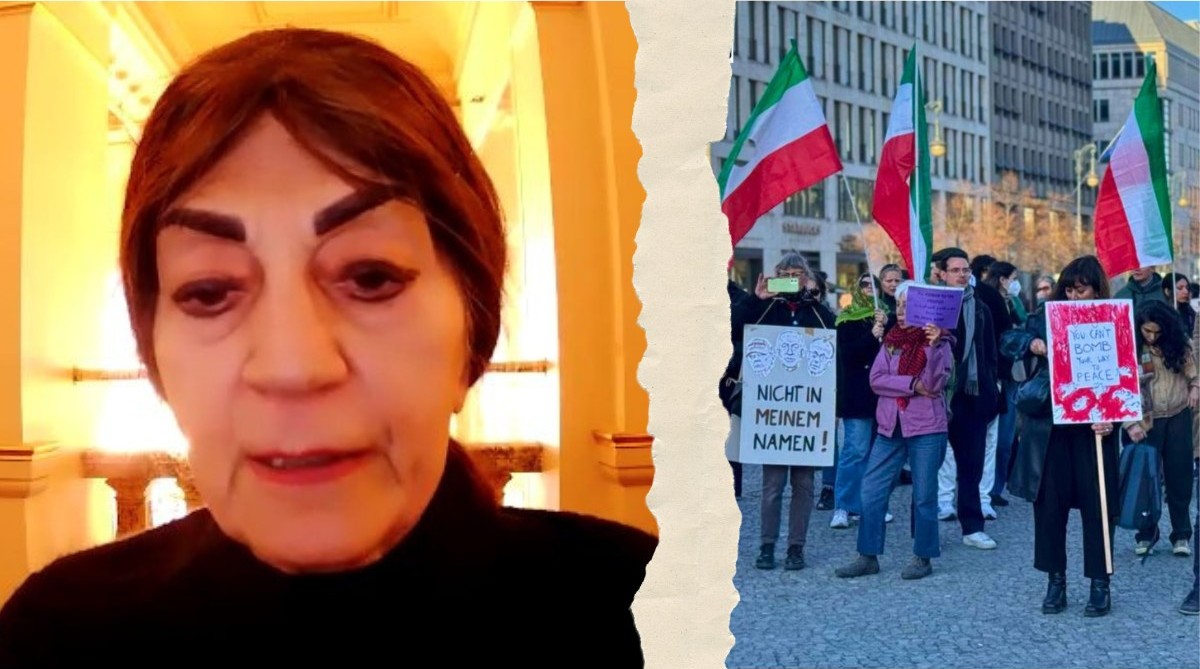
| The Persian version of this interview was first published first in RadioZamaneh.
The war against Iran has made it even harder to sustain the neat, one-dimensional image that many Persian-language and Western media outlets try to present of Iranians living abroad. In this dominant narrative, the “Iranian diaspora” is treated as if it naturally supports foreign intervention, the escalation of war, and even the destruction of Iran’s infrastructure. But according to Yassamine Mather, this image is not only false, it is deeply misleading.
Yassamine Mather, a senior researcher at Oxford and editor of the online journal Weekly Worker, speaks about the political, social, and class divisions among Iranians abroad: the differences between monarchists, layers of former reformists who have shifted to the right, professional migrants, students, and refugees; and why pro-war voices get far more media attention than their real social weight deserves. She also discusses the role of Western and Persian-language media in amplifying these voices, and in the end, she looks at Donald Trump’s latest threats and the wider horizon of war.
Your support helps keep this space alive but also ensures that these critical discussions remain accessible to all.
War and Division Among Iranians Abroad
How do you see the political divide among Iranians living outside Iran when it comes to the war? Are we dealing with an ideological split? And what about its social and class roots?
Yassamine Mather: This is not an easy question to answer, because each of us is only in touch with a limited part of Iranians abroad: friends, family members, political circles, or people we see in the media and on social media. So any judgment about what “all Iranians abroad” think is bound to be limited.
There are, of course, some opinion polls. For example, there was one survey among Iranians living in the United States which, if I remember correctly, showed that over 60 percent were against continuing the war in the past week and preferred it to end. But even those numbers are open to debate: how accurate the sample was, who responded, and who did not.
At the same time, it is clear that the United States, Britain, and some European countries are home to parts of the monarchist camp, people close to them, and groups aligned with Israel and Trump. This section has openly stood behind the war so far. But now that Trump is even talking about the destruction of “civilization” in our country, we have to see whether they will still stand behind him in the same way.
From the Old Elite to the New Right
If we look at this from a class angle, the issue becomes more complicated. Many people in Europe imagine that these forces represent “Iranian aristocracy,” but that is too simplistic. The Pahlavi monarchy in Iran did not have a long history, nor did it enjoy deep historical stability. On the other hand, many older families, including those who had studied in Europe for different reasons, did not necessarily identify with the Pahlavis. Some of them were at times even members of the Tudeh Party or other left-wing organizations. So you cannot simply say that “Iranian aristocracy” is the same thing as Pahlavi loyalism.
In fact, in my view, part of what could be called the old elite or the more traditional upper layers do not look positively on the Pahlavis at all. Just as in Britain the traditional aristocracy looks down on the newly wealthy middle classes, some of these layers see the Pahlavis as vulgar, uncultured, rude, or uneducated. I am not defending that view, I am only describing it. You can also see from their media and writings that they are not positive toward either the Pahlavis or Trump. Many of them do not accept Israel either, although that does not necessarily mean they support the Palestinian people.
But there is another section, especially in Los Angeles and Toronto: people who, to put it more precisely, were the financial losers of 1979. Many of them did not come from old wealth. Rather, they gained their status and opportunities during the Pahlavi period and were deeply tied to the economic order of that time. Among them, there are many former SAVAK figures, officers from the Pahlavi era, state functionaries, and others linked to that structure.
If you look at the social world they live in, you can see that their connection to the host society has often remained quite limited. They have their own neighborhoods, their own shops, and it is as if they have been frozen in 1979: from the way they dress and style themselves to the music they listen to at family gatherings. This is not only about income level. It reflects a very specific social and cultural position.
Right-Wing Reformists and Quiet Migrants
Alongside these groups, there is also a section of Iranians who, since the early twentieth century or in later decades, have had a broader connection with Europe and the United States and have become somewhat integrated into the culture of those societies. These people are usually less likely, at least in public, to openly defend Trump or Israel, because they live in environments where that kind of position is seen as disgraceful. In other words, they have become integrated enough into mainstream Western culture to avoid expressing such views openly, at least at the public level.
But we should not forget that over the past 47 years, a very large population has left Iran: political refugees, people forced out by repression, people who migrated because they could not find work matching their education, students, professionals, workers, and many others. This broad population has been absorbed into very different social layers. The monarchists have managed to draw in part of this wider group.
What I find interesting is that some former defenders of the Islamic Republic, meaning parts of the reformist camp, shifted to the right quite easily after the Green Movement and the events of 2009 pushed them into exile. If you look closely, these were people who had a problem with the Islamic Republic mainly over the 2009 election, but not with capitalism, neoliberal economics, privatization, or the existing class order. So once the part of the ruling system they had supported was no longer there for them, it was only natural that many of them moved toward the right.
Alongside them, we also have a large population of students, job migrants, and professionals who mostly stay silent or do not openly support the war. That does not necessarily mean they have no clear position. More often, it means they are trying to get on with their lives and their work. Even so, from what I see on social media at least, support for the war is not the dominant view among them either.
For example, many of the people I know work in British hospitals: nurses, surgeons, doctors, and other healthcare staff. For them, openly defending Trump would be genuinely shameful. I would speak more carefully about other countries, but in Britain this is really seen as embarrassing. In Spain, this sensitivity is even stronger. In France too, after some recent developments, defending this kind of war is not exactly something people can easily sell.
The same goes for students. They study in environments that, in recent years, have repeatedly seen sit-ins, building occupations, and protests in support of Palestinians. In that atmosphere, the word “genocide” is commonly used in connection with Israel. So it is hard to imagine that a large part of these students would support a war that has now become a dead end for Trump even inside the United States itself.
How the Media Builds a False Image
Even so, the image that Western media creates of Iranians abroad mostly works in favor of that same pro-war section. This is despite the fact that there are other currents as well, ones that have taken a stand against the war and have built their own anti-war campaigns. How do you assess this kind of representation?
Yassamine Mather: You have pointed to something very important. First of all, even the word “diaspora,” when it is used as if it describes one united whole, is itself misleading, because it wipes out all the diversity we have just been talking about.
The problem with these media outlets is that many of them, even when they are Persian-language, are ultimately tied to the political and financial structures of governments that are themselves invested in this war: the United States, Britain, Israel, and others. When a media outlet is basically a propaganda machine, that is obvious enough. But even outlets that claim to be professional and independent are still shaped by the policies of the states they operate within.
Take the BBC, for example. Part of its funding may come from public sources, but its World Service is still deeply influenced by British foreign policy. The current British government, even if it presents itself as “not directly involved,” has in practice stood alongside Israel. We saw that in Gaza too. Britain’s current foreign secretary has, basically, a very limited understanding of the region. Starmer himself, along with the home secretary and the defence secretary, all belong to the Labour tradition of being politically close to Israel. In that situation, it is not realistic to expect the country’s major media machine to suddenly become the voice of the people of Iran or Palestine.
In my view, the political line of some of these media outlets is not accidental. Editors can still make changes at the level of detail and presentation, of course. But in every debate and every report, that overall direction shows itself. The decision about which voices to amplify and which voices to erase is a political choice.
From “the Voice of the Iranian People” to the Selective Choice of Voices
For example, just today, on April 7, BBC English had to correct one of its news reports. It had said that a 21-year-old in Tehran had told them: “Even if they drop an atomic bomb on our heads, we are fine with it.” Now, in any big city, you can probably find someone who, out of despair or emotional breakdown, says something like that. But should a responsible media outlet really present such a statement to the world as if it reflects the feelings of the people of Iran? Should there not be at least some minimum level of judgment and professional responsibility?
On the other hand, why do anti-war stories disappear? On March 7, there was a major demonstration in London against the war on Iran. At least 80,000 people were there. Yes, the so-called “Axis of Resistance” forces had their own bloc, and we had ours, but a large number of anti-war and anti-Islamic Republic Iranians were present at that protest. Did Persian-language media reflect that? Almost not at all.
The same happened with the half-a-million strong anti-racism protest in London. A large number of Iranians were there too, including people who had not joined a protest for years. Was that covered? Again, no. When you keep putting the news spotlight on pro-war voices in a systematic way, the overall public picture becomes distorted.
The problem is that, in these conditions, being able to contact Iran is itself a class privilege. Someone who can afford internet access for online calls and has a higher degree of safety is much more likely to be heard. A petrochemical worker whose workplace has been bombed and who now faces the risk of unemployment is not going to call a Persian-language journalist. The person who does call is usually someone you know, or a relative, and by the end of the call they mainly want to say that they are alive and okay. If that same person also says something that fits the media outlet’s preferred line, they quickly become “the voice of the Iranian people.”
In the first days of the war, we saw many stories like this: “People in Iran are happy about the attack” or “they welcome the bombings.” But the longer the war has gone on, and the more destruction there has been, the fewer such voices we hear. People are more afraid now. The worries are deeper. I myself go to sleep in fear and wake up in fear, wondering what they hit this time: which university, which hospital, which scientific center, which industry.
The Media’s Responsibility in the Face of Disaster
In that sense, the Financial Times was interesting to me. It was the only major British newspaper that, from the very beginning, wrote that many people in Iran, including those who had taken part in the January protests or in the Woman, Life, Freedom uprising, were against the war. Meanwhile, a large part of the rest of the media simply translated and repeated baseless claims and propaganda coming from pro-war Persian-language outlets.
In my view, if this destructive process continues and leads to the collapse of Iran’s infrastructure, every single one of these media outlets, and everyone who helped reproduce this line, will bear responsibility for the disaster that follows. The media is not supposed to be a loudspeaker for any random thing it hears from anywhere. There has to be at least a minimum of common sense, judgment, and professional responsibility.
Trump, the Final Threat, and a War That Does Not End
This brings us to Trump’s statements today. Once again, he spoke about destruction and devastation, pushing his threats to the highest level. At the same time, his vice president also talked about intense developments in the coming hours. How do you assess these remarks? Where do they push the war in qualitative terms?
Yassamine Mather: To be honest, this is not an easy question to answer either, because it is genuinely unclear which of Trump’s words should be taken seriously and which should be understood as psychological warfare. Part of what he says is clearly coercive diplomacy and psychological pressure. But another part cannot simply be dismissed, because he himself is also unpredictable to a certain degree.
His vice president, J.D. Vance, as far as we know, was against this war from the start. Even Haaretz reported that last week he angrily called Netanyahu and said: you told us this would all be over overnight, you said they would welcome us with celebrations, but now look at the swamp we are stuck in. That too is one sign of division inside the camp supporting this war.
But on the other hand, we also need to understand what this war means for Trump himself. If you look at what he has been saying over the last two years, every time he talks about Iran, he goes back to the Carter era and the hostage crisis. For him, that period marks the beginning of America’s decline. And now, in one of history’s bitter ironies, he has found himself trapped in a situation that reminds him of exactly that moment: a long crisis, no clear victory, high costs, and political embarrassment.
There is no doubt that the United States and Israel have superiority in air and naval power. But it seems that the Islamic Republic’s capacity in drones, cheaper missiles, and attritional warfare has been far greater than the planners of this war expected. Whatever calculations they made, they got this part badly wrong.
I do not say this to mean that the Islamic Republic is winning. I do not see it that way at all. But the fact that, after all these days, this war still has not produced the outcome the United States and Israel wanted is, for Washington and for Trump personally, a sign of weakness. And that makes him even more angry. The more this deadlock continues, the more his insults, threats, and apocalyptic tone increase. If you look at his statement from Sunday, it was full of abuse and aggression. Today he is talking about the destruction of “civilization.”
This may be nothing more than a final threat meant to weaken morale. But it is also possible that it opens the way to even greater disasters. What has happened so far, in any case, has placed its main burden on the people of Iran, not on the rulers. The regime may fall, it may change, or things may become even worse. We still do not know what scenario lies ahead after this war. But almost every scenario we can see right now offers no positive horizon for the people of Iran.
It Is Society, Not Just the State, That Is Being Destroyed
In the final part of this conversation, Yassamine Mather stresses another point: it is the people of Iran whose universities have been bombed, who have lost their Pasteur Institute, whose petrochemical industry in Bushehr has been damaged, and whose steel industry has been wrecked. When Netanyahu proudly says that “we smashed their steel industry so they can no longer build heavy weapons,” it has to be said that steel is not only for weapons. Steel is a foundation of industry, construction, infrastructure, transport, and everyday life. This destruction is aimed at society.
Workers were present in those factories and industries when they were bombed. It is not as if empty spaces were being targeted. So any talk about “military targets,” when we are facing this scale of social and economic destruction, is deeply misleading.
That is why I speak cautiously. I do not want to predict anything with certainty. But one thing is clear: the longer this war goes on, the greater and more irreversible the costs for Iranian society will become.


Yasmine Mather makes very important points. Sweeping generalisations about the Iranian diaspora blur all the important distinctions between different sections of it, and the role of mainstream media in highlighting a minority while silencing a much larger section. Her interview deserves to be circulated widely.