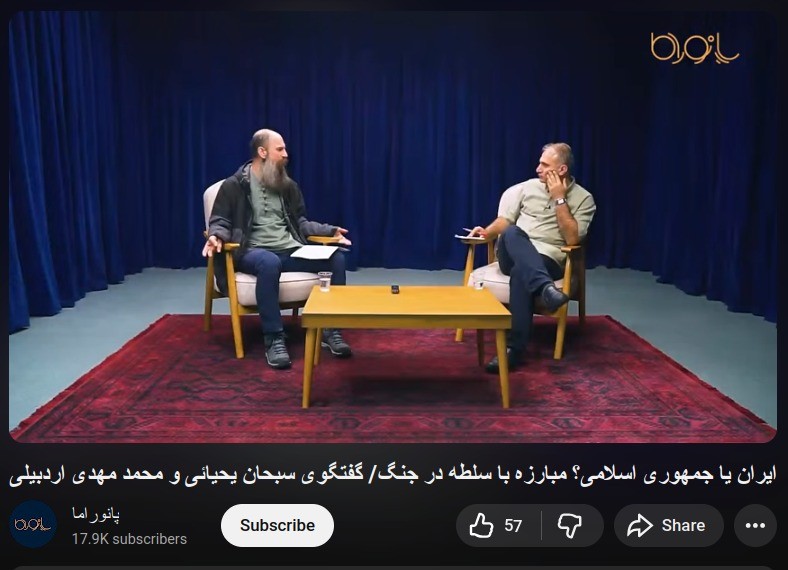
One month after the start of the US-Israeli war on Iran, a long conversation was recorded in Tehran between Sobhan Yahyaei, a media researcher and host of the Panorama podcast, and Mohammad Mehdi Ardabili, a philosopher and public intellectual. This was not just an abstract discussion. In the middle of the conversation, they say they could even be arrested for saying these things. The sound of explosions and air defense can be heard in the background. That alone gives the conversation a special weight. But its importance is not only about the conditions in which it was recorded. It matters because it brings up one of the central political questions in Iran today: when a country is under military attack, how should the relationship between opposition to foreign aggression and opposition to domestic despotism be understood?
Your support helps keep this space alive but also ensures that these critical discussions remain accessible to all.
As the interviewer, Sobhan Yahyaei moves the discussion through ideas like homeland, war, responsibility, and everyday life under bombardment. Mohammad Mehdi Ardabili, known as a philosopher shaped by Hegel, continental philosophy, and theoretical debates on politics and suffering, tries to respond to the exceptional condition of war. He clearly says that he is sympathetic to the Woman, Life, Freedom movement, that he does not deny the Islamic Republic’s repression, and that he does not defend domestic despotism. But from these same starting points, he reaches a conclusion that has both serious listeners and serious critics in Iran today: in wartime, priority must be given to resisting foreign aggression, even if that means temporarily suspending conflict with the Islamic Republic.
This article is written neither to rush into condemning that position nor to defend it. The point is to understand what is actually being said in this conversation, why it sounds reasonable to part of Iranian society, and at the same time what limits and dangers this framework carries.
A conversation in Tehran, not in a safe studio abroad
The importance of the conversation is clear from the beginning. This is not a calm panel in Paris or London. It does not come from a safe distance from war, and it is not a discussion floating in a vacuum. Several times, the speakers mention the internet blackout, the heavy security atmosphere, and the fact that it is not even clear how or where this conversation will be published. At one point, Ardabili says, “Right now, we may not even finish this conversation. They might come in here and take us away.” Whatever the immediate practical risk was, that line tells the reader and listener what kind of space this discussion comes from.
That matters because part of the weight of the conversation comes from exactly this. When someone speaks from inside a bombed Tehran, in a space marked by fear, explosions, internet restrictions, and security pressure, and says that resisting foreign attack must come first, that position cannot simply be reduced to intellectual play or a mechanical repeat of the official line. But that is also what makes criticism of it more serious and more difficult. This is a position coming out of a real condition, not from outside it.
Who has the “main responsibility”? Domestic repression or foreign war?
One of the clearest parts of the conversation is where Ardabili separates responsibility for domestic repression from responsibility for foreign war. He reminds the audience that when the state massacres protesters, “the main responsibility” lies with the Islamic Republic. But in wartime, he says, “right now, the main responsibility definitely lies with the United States and Israel.” That sentence matters, because it forms the core of his analysis.
In his view, if the government represses and massacres people inside the country, that must be named directly. But when war is imposed from outside, bombing, destruction, and killing cannot be explained with the same logic. In that case, the aggressor that launches the war is the main responsible actor. In other words, for him politics has to distinguish between different layers of violence, instead of collapsing everything into one slogan.
For many non-Iranian readers, this is an important point. In many outside narratives, Iran appears only through the face of the Islamic Republic. As a result, the distinction between people, society, the state, and the condition of war disappears. In this conversation, Ardabili tries to show that someone can be hostile to the Islamic Republic and still condemn foreign attack as aggression.
Rejecting two camps: neither unconditional loyalty nor bombing as liberation
Another major part of the conversation is his rejection of the two dominant camps. Ardabili clearly distances himself from those who, in the name of war, demand unconditional loyalty to the Islamic Republic. At the same time, he distances himself from the other side: those who see foreign attack as a path to freedom, those who, in his words, say “thank you Bibi,” or look at bombing as some kind of rescue project.
He does not frame this position as compromise or as moral moderation. His argument is that one can oppose domestic despotism and reject war at the same time. In this sense, not every enemy of the Islamic Republic is a friend of the Iranian people, and not every criticism of war amounts to support for the regime. This point is especially important for readers outside Iran, who often encounter a flattened media picture in which Iranian society is reduced to only two poles: either with the regime, or with bombing against it.
In that same line, Ardabili pauses over the idea of being “appropriated.” He says that if you speak against war, the regime may use your words. If you stay silent, pro-war forces will appropriate that silence too. So he does not see silence as the answer. For him, silence is a kind of moral “beautiful soul” position: the illusion of staying pure and untouched by politics. The answer, in his view, is to speak clearly while trying to block manipulation from both sides.
“In this war, at this moment in history, Iran and the Islamic Republic are one”
But the central knot of the conversation lies elsewhere. In one of his key lines, Ardabili says: “In this war, at this moment in history, Iran and the Islamic Republic are one.” This may be the most important and most controversial core of the whole discussion.
He immediately explains that he does not mean the Islamic Republic is sacred. His point is that defeat of the Islamic Republic in this war would mean defeat of Iran, collapse of the country, and possibly even partition. For that reason, in this particular moment, he argues, it is not easy to separate the survival of Iran from the survival of the regime. His claim is that the attacking powers have no real plan for a free and democratic Iran. What they want, he says, is a weak, fragmented, and subordinate Iran.
This is the part of his argument that finds an audience inside Iran. After Iraq, Syria, Libya, and the broader regional experience, the fear of collapse, civil war, “Syrianization,” and “liberation from outside” is very real. Many Iranians, including those who deeply oppose the Islamic Republic, are not easily convinced that foreign bombing can lead to freedom. That is why Ardabili’s words do not come out of nowhere. They rest on a real fear and a deeply accumulated regional experience.
But this is also exactly where the main problem begins. Must defending Iran against bombing necessarily pass through suspending conflict with the Islamic Republic? Is defending society, people, homes, and the infrastructure of life the same thing as defending a state that has repressed that same society? This is the point where the conversation, knowingly or not, moves toward a dangerous edge.
“I shake the hand of the one standing at the launcher”
One of Ardabili’s most revealing lines is this: “That military force standing at the launcher right now, I shake his hand… but that same person, if this war ends and he picks up a baton and hits me on the head, then I have to stand against him.” This sentence contains both the strength and the limit of his argument.
Its strength is that it does not hide the contradiction. He does not say the repressive apparatus has suddenly become innocent. He does not say the person who appears today as a defender of the country will never again become an agent of repression. On the contrary, he openly says that the same hand may later hold a baton. In that sense, he is not blind to the return of repression.
But the limit of the argument is right there too. If the return of repression is not some distant possibility but part of the reality itself, then the obvious question is this: from whom exactly is this wartime “prioritization” being demanded? The Panorama conversation effectively asks society to temporarily suspend its hostility toward the regime. But has the regime suspended its war on society? Has it stopped executions in wartime? Has it stopped arrests, repression, internet blackouts, media suffocation, and total securitization? If not, why is restraint always demanded from below, and not from above?
This may be the most important criticism one can make of this kind of framework. The problem is not that foreign aggression is unreal. The problem is why, in every crisis, society is told to step back, be patient, understand priorities, and postpone reckoning, while the state is not. In that sense, the danger of this language is that it can unintentionally lead to a one-sided ceasefire with the regime.
Homeland, grief, and everyday life under bombardment
Still, the conversation is not only about the state and war. One of its most human and important parts is about grief, rage, trauma, and survival. Ardabili says Iranian society has not even had the chance to properly mourn some of its massacres, and that this unfinished grief has become mixed with anger, anxiety, and despair. In his view, this raw and unprocessed anger can turn into a blind force and even feed disastrous fantasies, including the hope that foreign war could bring freedom.
From there he moves into a discussion that is less common in everyday political conversations: breathing, discipline, meditation, helping neighbors, keeping daily life going, watering plants, and maintaining a kind of mental steadiness under bombardment. One may agree or disagree with this language, but this part of the conversation shows that, for him, resistance is not only about taking political positions. It is also about preventing the psychological collapse of society.
This part should not be dismissed. A society living under both foreign bombardment and internal pressure does not survive on geopolitical analysis alone. But at the same time, this human dimension must not become a cover for erasing the question of the state. Psychological calm, resilience, and meditation are no longer neutral or innocent if they mean forgetting repression or handing over the whole field to the government.
Why this conversation matters
The Panorama conversation matters because it shows that inside Iran there are not only two voices: the official state voice and the voices of outside war advocates. Between them, there are other voices trying to oppose foreign aggression while also refusing full identification with the Islamic Republic. That effort itself points to the complexity of the Iranian political scene.
But the conversation is important in another sense too: it is important because it is risky. The risk is not that it fears war or talks about destruction. The risk is that, at key moments, it moves the defense of Iran toward a language that can end up serving the state. When someone says, “In this war, at this moment in history, Iran and the Islamic Republic are one,” or when society is asked to push its conflict with the regime into the background for now, the line between defending people and restoring the state’s legitimacy becomes very thin.
For non-Iranian readers, the main lesson may be this: opposing war in Iran does not automatically mean supporting the Islamic Republic. But at the same time, not every anti-war language keeps a real distance from the state. The real struggle lies in that narrow space.
It is possible to oppose war without declaring a ceasefire with the state. It is possible to defend people under bombardment without forgetting that the same state has not stopped its war against them. Any analysis that erases either of these truths ends up serving either war or power.


