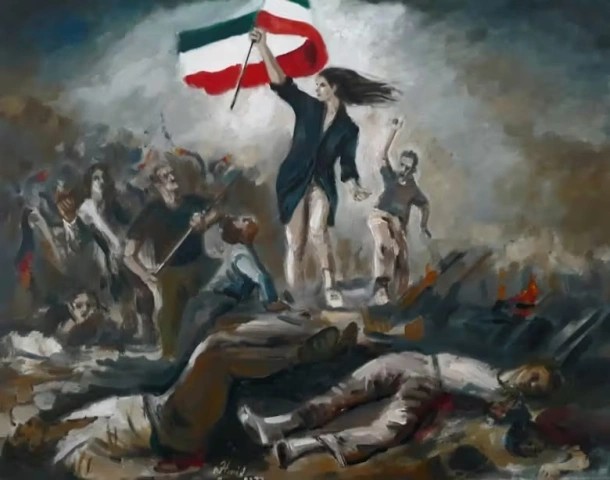
One of the laziest clichés about Iran is the idea that a single, unified “people” are standing against a single, unified “regime.” This formula works well for headlines, for rushed journalism, and for simple moral commentary. But when it comes to understanding real politics, it is almost useless. Iranian society is not a homogeneous block. It is a field of conflict between opposing political projects. War, repression, the dead end of reform, the collapse of political legitimacy, and the memory of bloody uprisings did not create these divisions or invent them. They simply brought them back to the surface.
This is exactly where the importance of Yashar Darolshafa’s essay begins. He is not merely trying to say that Iranian society is diverse. Everyone already knows that, and repeating it does not clarify much. His real point is something deeper: in today’s Iran, “the people” is not the name of a political unity. It is a site of struggle. Every political project creates its own people, names its own enemy, defines what costs are acceptable, and gives its own shape to the future. That is why the main question is no longer “what do the people want?” The real question is: which people, with what understanding of freedom, survival, justice, war, and change?
Your support helps keep this space alive but also ensures that these critical discussions remain accessible to all.
For the non-Iranian observers, this point matters even more. A large part of international writing on Iran still moves between two simple poles: an authoritarian state on one side, and a society seeking freedom on the other. But what is seen from outside as “the Iranian people” is not, in fact, a single camp. Within it, there are at least four competing political horizons.
They differ not only in their relationship to the Islamic Republic, but also in how they understand the problem itself. For one, the central issue is survival. For another, it is the fall of the regime at any cost. For a third, it is a secular and legal transition. And for a fourth, it is social revolution against the regime, imperialism, and the dominant class order all at once.
Darolshafa’s text should be read as a map of this very fragmentation.
From What Perspective Does Darolshafa Write?
Yashar Darolshafa cannot be seen as just another political commentator. His writing usually moves along the border between political economy, academic life, the history of student struggles, and the critique of both official and opposition narratives about Iran. This background matters, because it explains why, in his work, “the people” is not treated as a moral or abstract concept, but as a material, historical, and contested category. He writes from a perspective that tries to pull politics down from the level of broad slogans about nation, freedom, and democracy, and return it to the level of social forces, lived experience, and conflicting interests.
Yashar Darolshafa is a leftist researcher and political and student activist who has had a continuous presence in Iran’s student movement since the mid-2000s. He was a PhD student in Social Welfare and Social Health at the University of Social Welfare and Rehabilitation Sciences, and his dissertation focused on the impact of labor protests on workers’ welfare in post-revolutionary Iran. At the same time, he has written many articles on Marx studies, the history of workers’ struggles, and political economy.
Darolshafa is one of those figures who has helped connect the left, the university, and the experience of prison. From the arrests that followed the student movement of the 2000s to later sentences after the November 2019 protests, he has spent a long part of his life under the pressure of state repression.
In this sense, his essay is more than a cold classification. It is a kind of intervention in the field of interpreting Iran. An intervention against two simplifications at the same time: against those narratives that completely dissolve the people into the regime, and against those that reduce the people entirely to the liberal or monarchist opposition.
These four political formations did not fall from the sky. They are the product of a dense decade of crisis: economic collapse, the bloody repression of protests, job insecurity, the destruction of everyday life, the failure of hopes for reform, war and sanctions, and the growing sense that the Islamic Republic is not just beyond reform, but structurally set against its own society. Yet this shared experience has not led everyone to the same conclusion. On the contrary, different and even opposing answers have emerged from the same crisis.
This is exactly where Darolshafa speaks of “four peoples.” Of course, this classification is not absolute or rigid. Its boundaries are fluid, and in social reality they often overlap. But as an analytical tool, it helps us understand why people living in the same country, under the same sky, and sometimes even within the same economic class, can imagine the future in completely opposite ways.
The First People:
Those Who See the Islamic Republic as Part of Their Own Survival
The first formation includes those who, in a moment of crisis, stand with the Islamic Republic. Darolshafa makes an important point here: this social base should not be explained only through the idea of rent, privilege, or material benefit. That explanation captures part of the truth, but it misses the heart of the matter. A part of the Islamic Republic’s support base has a genuinely identity-based, ideological, and existential relationship with it. For this group, the regime is not simply a machine of repression. It is also a kind of shield against the outside world, against the West, against historical humiliation, and at the same time a leftover form of a justice-oriented language speaking in the name of the mostazafin, the oppressed.
This point is essential for any serious analysis of Iran. Economic hardship does not automatically turn into opposition to the regime. A worker, a poor person, someone on the margins, or someone from the lower classes can still find meaning for their suffering inside the Islamic Republic’s religious and anti-Western narrative. They may see the corruption, yet still feel, at a deeper level, that the regime is “their own.” In Darolshafa’s text, these people are named in a way that already carries a worldview: the “Nation of Imam Hussein.” In other words, a people who understand survival, resistance, religion, and the state as one political package.
This formation cannot simply be dismissed with mockery. If it is not understood, one of the most real sources of the Islamic Republic’s durability will be ignored.
The Second People:
Those Who Welcome War as a Shortcut to Liberation
At the opposite pole, Darolshafa speaks of those who welcome the fall of the Islamic Republic through war and foreign intervention. This part of society, especially after the repeated defeat of protest movements, has come to the conclusion that there is no internal path left for overthrowing the regime. So if an external force appears ready to do what the people could not, it should be welcomed, even if the price is destruction, civilian deaths, and the collapse of social life.
Here we are dealing with a deeply important political and moral logic. For this force, the main issue is no longer war crimes or bombardment. The main issue is: we could not do it ourselves. And that very sense of failure later turns into justification. The deaths of ordinary people, the destruction of infrastructure, and the ruin of cities are redefined in this logic as the “necessary cost of freedom.” Foreign attack is understood not as a catastrophe, but as a painful yet necessary blow.
This formation, too, should not be explained through shallow contempt. Yes, this horizon is politically and morally reactionary, and deeply dangerous. But it did not emerge from nowhere. It grew out of defeat, despair, prison, repression, and the collapse of trust in the possibility of collective action inside the country. In today’s symbolic language, Darolshafa describes this pole as the “Nation of the Lion and Sun.” The title is not just a historical reference. It names a contemporary political project: overthrow-focused nationalism, ready to connect itself to foreign war.
The Third People:
Anti-Regime, Anti-War, and Oriented Toward a Secular Transition
But Iran cannot be understood only through these two poles. The third people are the part of society that opposes both the Islamic Republic and foreign intervention. For many Western readers, this is probably the most familiar face of the Iranian opposition. Its horizon is expressed through words such as secularism, republicanism, civil rights, referendum, parliamentarism, and peaceful transition. From the point of view of this current, the solution lies neither in the survival of the Islamic Republic nor in the bombing of the country, but in opening political space, pushing back the ideological structure of the state, and moving institutionally toward a secular republic.
Darolshafa places this group within a very specific history: the history of religious intellectualism, reformism, and republican thought after the failure of the reform movement. His reference to the 1990s, to the journals of that period, and to names such as Soroush, Shabestari, Ganji, Arendt, Habermas, and Isaiah Berlin matters for exactly this reason. He wants to show that this horizon is not new. It is the transformed version of the same project that once tried to guide the Islamic Republic toward a kind of secularism compatible with the market, human rights, and parliamentarism.
The same logic appears in this current’s analysis of war. The United States and Israel are criminal actors, but the root cause of war is ultimately traced back to the Islamic Republic’s foreign policy, its nuclear project, its idea of strategic depth, and its Shiite state ideology. In other words, war is understood as the logical result of the regime’s adventurism, not as a product of the aggressive structure of imperialism and Zionism. It is exactly at this point that Darolshafa highlights the gap between the third people and the fourth.
The Fourth People:
Those Who See Change Without Justice as Counterrevolution
In Darolshafa’s text, the fourth people are the most important and the most radical formation. Their difference from the third people is not simply a matter of being more radical. The difference lies at the level of the problem itself. The third people see the main problem as “religious government.” The fourth people say that this is only one part of the issue. If capitalism, wage labor, subcontracting, poverty, national oppression, gender domination, the subordination of women and queer people, and the destruction of the environment by the logic of profit remain untouched, then regime change by itself solves nothing.
From this perspective, the Islamic Republic may fall, and yet the same basic relations of domination may continue, only with a more secular and more acceptable face. Workers may still be excluded from control over their workplaces. Women may still remain trapped under a patriarchal order. Oppressed nations may still face a centralizing state. The environment may still be sacrificed to profit and rent. In such a situation, what has happened is not freedom. It is only the replacement of the managers of an unequal order.
Here Darolshafa makes a key distinction: the distinction between “regime change” and “revolution.” For the fourth people, social revolution is impossible without political revolution, but political revolution without social revolution is entirely possible. In other words, the regime may change while the structure of domination remains intact. That is exactly what he refuses to call a revolution.
In this sense, the fourth people can be described as the horizon of the working class and the oppressed. Not only because, sociologically, they largely come from those layers, but because they are the only force trying not to separate the question of freedom from the questions of bread, labor, national oppression, gender, and material equality. They oppose the regime, imperialist war, and also an opposition that postpones social justice until “later.”
Breaking with the “Axis of Resistance Leftist”
One of the sharpest points in Darolshafa’s text is the line he draws against what he calls the “axis of resistance leftist.” This tendency sounds close to the fourth people in its criticism of the United States and Israel, but in his view it fails at a decisive point: it is unwilling to accept the necessity of a political revolution against the Islamic Republic itself. At times, it seems to imagine that some form of social transformation can be pushed forward from within the state apparatus, or through reliance on parts of the ruling structure and the military forces.
Darolshafa rejects this view. Geopolitical opposition to the United States does not, by itself, give the Islamic Republic an anti-imperialist character. A regime that is anti-worker, represses women, advances neoliberal policies, and governs society through a security apparatus does not suddenly become a force of liberation simply because it is in conflict with the West. This distinction matters because it separates the fourth people from both sides at once: from the regime-change right, and from the state-believing left.
The real strength of Darolshafa’s text is that it shows the main divide in Iran is not simply about who supports the Islamic Republic and who opposes it. The deeper issue is a struggle over the meaning of change itself. For the first people, survival comes first. For the second, the fall of the regime at any cost. For the third, a secular and legal transition. And for the fourth, social revolution.
This is not just a disagreement over tactics. Each of these projects produces its own people and speaks in their name. One calls on the “Nation of Imam Hussein.” Another invokes the “Nation of the Lion and Sun.” The third speaks of the “Iranian nation” or “the people of Iran.” And the fourth speaks of the working class and the oppressed. The conflict is not really over words. It is over hegemony. It is about which force gets to present itself as the true political voice of society.
Why Does This Essay Matter?
At a time when Iran is often seen either only through the lens of the state and war, or only through the language of human rights and moral judgment, Darolshafa reminds us that none of these levels is enough on its own. War cannot be understood without class. Class cannot be understood without repression. Repression cannot be understood without geopolitics. And none of them can be explained without the lived experience of the real forces inside society.
The person who dies in a mine, the person who faces bullets in the street, the person who chants in a state rally, the person who welcomes bombing, and the person who speaks of legal transition all live in the same country. But they do not live inside the same political world. That is exactly the truth that simplified narratives about Iran keep hiding.
Darolshafa’s text matters because it disrupts that concealment. It pulls “the people” down from the level of a sacred and shapeless word and brings it back to the real ground of politics: to interests, fears, memories, defeats, and materially opposing horizons.
Iran today can no longer be understood through the formula of “the people versus the regime.” What is taking place is not simply a conflict between state and society. It is also a conflict between different formations within society itself. Every political project invents its own people, chooses its own legitimate suffering, names its own main enemy, and defines its own desired future.
In that sense, the importance of Yashar Darolshafa’s text is not only in this four-part naming. Its real importance is that it forces us to step outside the misleading title of “the people” and ask which forces are actually fighting to seize Iran’s future. Iran’s future will not emerge from one unified national will, but from the struggle between these opposing horizons.


