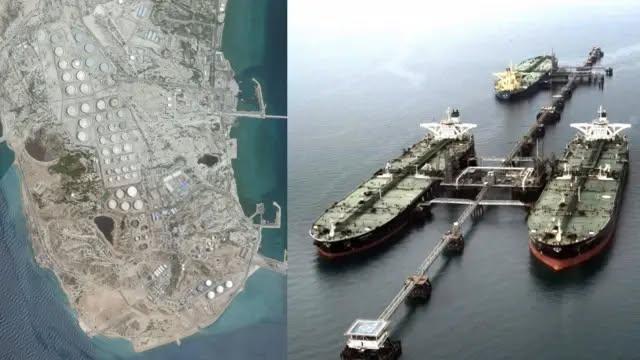
The US attacked Kharg, but it did not hit Iran’s oil export terminal there. That apparent contradiction may explain the nature of this war better than any official statement. Kharg is not just an island. It is a place where military force, the Iranian state budget, oil tanker routes, and the nerves of the global energy market all come together in one small point.
When Washington hits the island’s military facilities but leaves the oil infrastructure untouched, it is basically admitting that even the strongest military power in the world cannot fully control everything it attacks. Sometimes the target itself is so deeply tied into the structure of the global economy that destroying it would not only hurt the enemy, but also set off a chain of crisis against everyone.
Your support helps keep this space alive but also ensures that these critical discussions remain accessible to all.
This is exactly where Kharg’s importance lies. Reuters has reported that around 90 percent of Iran’s oil exports pass through this island, that it has around 30 million barrels of storage capacity, and that serious damage to its terminals could cut about 2 million barrels a day from global supply. Even after the war began, Iran was still exporting around 1.1 to 1.5 million barrels a day from Kharg, mostly to China.
That means Kharg is not just a facility. It is the main artery that turns underground oil into cash, state revenue, imports, and the financial survival of the government. The US knows this, Iran knows this, and the market understands it better than anyone. That is why an attack on Kharg, if it reaches the heart of its oil system, is no longer just a tactical operation. It becomes a strike on a systemic knot.
But Kharg cannot be understood separately from Hormuz. The issue is not only how much oil Iran exports. The issue is that this war is happening in a place where around one-fifth of the world’s oil passes through. Reuters and the International Energy Agency have described this crisis as the biggest supply disruption in modern history.
Brent has gone back above 100 dollars, emergency reserves have been released on an unprecedented scale, and even that huge intervention is still only working like a painkiller. Once the battlefield reaches a real chokepoint of the global economy, you can no longer move forward with the simple logic of “bomb it and finish it.” War stops being only a military conflict and turns into a machine for producing crisis in the global market.
That is why not hitting Kharg’s oil terminal is not a sign of total American weakness, but it is also not a sign of unlimited freedom of action. Washington can strike, but it cannot be sure the consequences will stop there. Iran has also clearly warned that attacks on its energy infrastructure could be answered with attacks on the infrastructure of US-allied countries, and the drone strike on Fujairah was a reminder that this threat is not just words.
In this situation, the US decision to hit military targets while avoiding the destruction of the oil network looks less like moral restraint and more like an admission of a structural brake. That brake is not Washington’s love of peace. It is fear of an energy shock, disruption in insurance and shipping, and price spikes hitting the empire’s own legs.
This war has not only shaken the crude oil market. Reuters has reported that the current crisis has hit refined products even harder than crude itself. Diesel prices in Singapore have jumped 57 percent and jet fuel 114 percent. China has immediately stopped fuel exports, and countries that depend on imported fuel have moved toward rationing, lower refinery activity, and emergency stockpiling. This is the point where the energy issue goes beyond crude oil and connects directly to daily life, transport, agriculture, mining, industry, and the livelihoods of millions of people. When the Strait of Hormuz shakes, it is not only the Brent chart that moves up. Fuel distribution chains, the price of goods, and the whole outlook for economic growth shake too. Global capitalism looks very modern, but it still breathes through a few old choke points.
Meanwhile, Russia is neither the savior of the market nor a spectator outside the scene. Russia gets a double benefit from this crisis. On one side, the US has issued a 30-day waiver for some Russian oil and fuel cargoes already at sea in order to calm the market shock. On the other side, Putin has openly said that an energy crisis has arrived and that Russia is ready to work again with Europe.
This means that the same oil that yesterday was called “illegitimate” and “sanctioned” suddenly starts looking close to “necessary” oil in a moment of crisis. Of course, Russia does not replace Kharg. In 2025, Russia itself exported about 238 million tons of oil, and 80 percent of it went to China and India, not Europe. But even that is enough to open a crack in the sanctions regime and let Moscow once again show that it cannot simply be removed from the game.
In this whole scene, Europe is more an object of pressure than a decisive actor. Today the European Union is not shaping the field. It is trying to contain the consequences. Gas prices in Europe have risen by around 50 percent in two weeks, and the UN climate official in Brussels has reminded everyone that the EU still imports more than 90 percent of its oil and 80 percent of its gas.
At the same time, Brussels is looking at strengthening the Aspides naval mission, but any major change needs agreement from all 27 member states, and Germany is skeptical about extending it to Hormuz. This means Europe is not completely without agency, but its agency is weak, defensive, and fragmented. It is a continent with huge economic weight but a shaky geopolitical backbone. More than setting the direction, it is calculating the cost of other people’s game.
Trump has understood this limit too, and that is why he is using the Hormuz crisis as a tool to discipline allies. In recent days, he has openly warned that if NATO allies and countries benefiting from oil and gas passing through Hormuz do not help the US, the future of NATO will be “very bad.” Japan has said for now that it has no plan to send an escort mission, and Europe is still stuck between debate, doubt, and delay. This is not only about the security of shipping.
The issue is that the US wants to socialize the cost of the global energy order while keeping the political and military command in its own hands. In simpler words, Washington is saying: everyone should help carry the weight, but I will keep my hands on the steering wheel. That alone shows that American power in this war looks less like a clear, united will and more like rushed crisis management.
So the main question is not whether the US can destroy more of Iran. Of course it can. The more important question is whether it can turn that destruction into a controlled result that is low-cost and geopolitically manageable. So far, the answer is not clear. The more the war moves closer to Kharg, Hormuz, Fujairah, Qatar’s LNG, tanker insurance, and refined fuel markets, the more obvious the gap becomes between the “ability to destroy” and the “ability to contain the consequences.”
This is exactly where the myth of quick victory starts falling apart. Not because Iran has suddenly become unbeatable, but because the battlefield has moved beyond Iran’s borders and entered the very system that reproduces the global economy.
At this point, readers should understand that the issue of war over oil is no longer really about the regime ruling in Tehran. The further this war goes, the more clearly it shows that its logic has nothing to do with the safety of the Iranian people or the future of the region. This war can wound Iran even more, but at the same time it has exposed the limits of American power. The empire can still rain down fire, but it cannot guarantee that the fire will burn only the enemy’s house.
In the end, Kharg and Hormuz are not just two geographic names. They are the names of a moment when war breaks out of the control of its planners and turns into a crisis against the whole global energy order. If the US has not hit Kharg’s oil terminal, it is not because of humanity.
It has not hit it because it knows that place is no longer just Iranian soil. It is the point where oil, war, Russia, Europe, the market, and global fear all lock together. And that is the truth still standing there, stubbornly, underneath all the slogans of victory.


Very well argued.