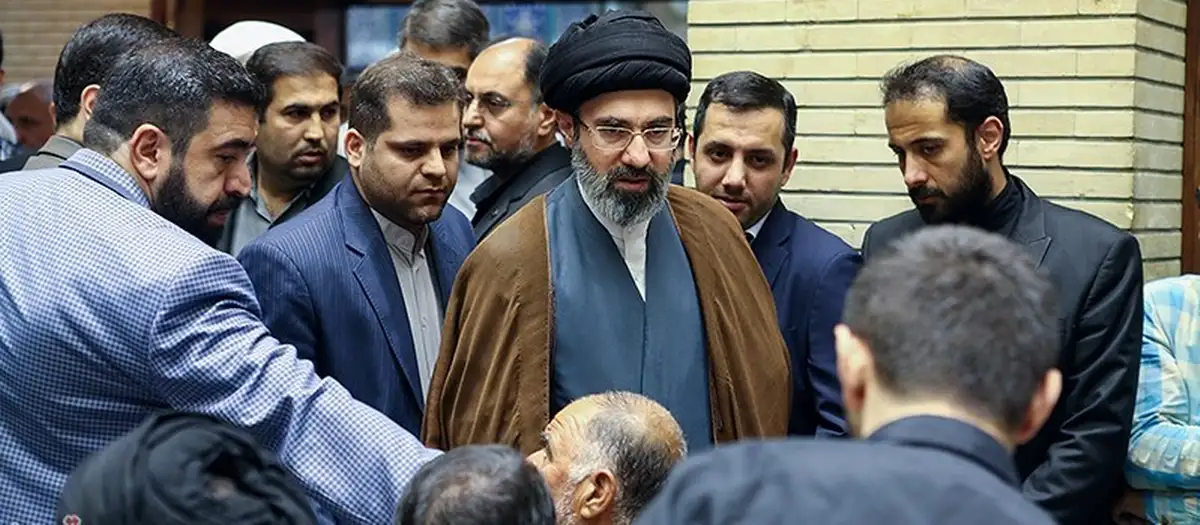
When it comes to Mojtaba Khamenei, the issue is not just whether he has become, or may become, his father’s successor. The more important issue is the kind of power concentrated around his name: faceless power, backstage power, security-driven power, and power deeply shaped by the logic of control. If we put together the many accounts that have emerged over the years, we are faced with a figure whose main advantage has never been public speaking, building public legitimacy, creating charisma, or even openly defending the system. On the contrary, his real strength has been precisely this: not being seen, and acting most effectively where he is not seen.
This is the key point. In the Islamic Republic, an important part of power has always operated in the dark. But in Mojtaba Khamenei’s case, that darkness is no longer just a side feature; it is his political identity itself. Over the decades, while his role in the most sensitive layers of the state has been mentioned again and again, there has been almost no direct public trace of him. No major speeches, no regular political positions, no classic ideological defense of the system. This absence is not accidental. It is exactly the kind of intervention through which one can understand why he is attractive to parts of the power structure: because he does not answer to society, to public opinion, or even to the recorded memory of politics. He stands in a position where he can shape outcomes without paying the full political cost of doing so.
Your support helps keep this space alive but also ensures that these critical discussions remain accessible to all.
The accounts published about his involvement in sensitive political and security matters point directly to this pattern. From engineering elections to deciding the balance of forces inside the regime, from his role in security networks to his closeness to figures such as Hossein Taeb, the image that appears is that of a classic operative of the “deep state.” If we take these accounts seriously, then we are faced with the idea that Mojtaba Khamenei does not represent political change, but rather the intensification of the same logic that has brought the Islamic Republic to this point: ruling through surveillance, file-building, pressure, control, and constant manipulation.
In this context, the reports about his interest in using private information, wiretapping, and spying against politicians are not just side details. This may be the dirtiest part of the story, but it is also one of the most revealing. It shows that what we are dealing with is not simply an ordinary power struggle. This is a kind of politics in which the line between security, vulgarity, blackmail, and governance almost disappears. In other words, the state reproduces itself not only through prison and street repression, but also through the accumulation of dirty information, psychological pressure, and the hidden control of its own elites. If this pattern was formed before succession, it is not hard to guess that it will continue afterward as well; in fact, it will most likely become heavier and more systematic.
There is an important contradiction here. For many factions within the power structure, Mojtaba Khamenei may look like a “solution.” But at the same time, he carries a lasting crisis within himself. The reason is simple: even if his succession is secured, that still does not mean the succession struggle is over. When power is transferred not on the basis of public consent or political legitimacy, but instead through security networks and closed-door agreements, it can turn back into rivalry and division at any moment. This is especially true when the whole system knows that the new leader, whoever he may be, has emerged not from a legitimate public process, but from a closed arrangement. In such a situation, succession does not solve the crisis. It freezes it. It covers it up for a while, but it does not remove it.
This is exactly where the project that could be called “moving beyond Khamenei through Khamenei” begins to make sense. This project rests on a double deception. On the one hand, it admits that the current order under Ali Khamenei has reached serious dead ends: structural corruption, exhausted legitimacy, social division, and political blockage. On the other hand, it tries to direct that very admission not toward a break with the structure, but toward a controlled renovation of the same structure. Put simply, it says: yes, things are bad, but the answer is neither revolution nor social intervention from below. The answer is “reform from above” carried out by the same hard core of power. In other words, the son criticizes the father, but only enough to save the system.
This is why the narrative of Abbas Palizdar matters from this angle. It matters not only because of what is being claimed, but because of the position from which those claims are made.
Abbas Palizdar is one of those controversial figures who first made major headlines in 2008, when his name became linked to the Seventh Parliament’s investigation into the judiciary. Known at the time as a collaborator and executive figure in that process, he used speeches and interviews to accuse dozens of senior officials, influential clerics, and central figures of the Islamic Republic of financial corruption and abuse of power. These accusations, which first gained wide attention at Bu-Ali Sina University in Hamedan and then spread across the media, quickly led to his arrest. Even back then, it was clear that Palizdar was not a classic independent journalist. He was more a product of internal struggles within the power structure itself: someone who had access to certain files, but whose intervention also carried the clear smell of political score-settling.
What makes Palizdar important today is not just his past, but the kind of role he plays in newer narratives. When he talks about widespread corruption during Ali Khamenei’s era, while at the same time presenting Mojtaba Khamenei as a figure capable of cleaning up and reforming the system, then this is no longer just a simple act of exposure. Here, corruption is being used not to challenge the system as a whole, but to rebuild it with a new face. In that sense, Palizdar is more than just a whistleblower. He becomes a sign of succession engineering and internal power rearrangement, a kind of political operation that tries to use public anger at the current situation in order to save the same order that produced it. This is, of course, a political reading of the function of his narrative, not a final judgment on every single claim he has made.
When someone, clearly backed by parts of the security apparatus, speaks of the deep corruption of Ali Khamenei’s era while at the same time presenting Mojtaba Khamenei as the face of reform and cleansing, we are not dealing with real criticism. We are dealing with a political operation. Here, criticism is not a tool for truth-telling. It is a tool for rearranging power. Corruption is exposed not so the structure itself can be questioned, but so that one part of that same structure can stand again on its own ruins with a fresher face.
The same logic can be seen in the rise of channels and platforms that, at certain moments, began openly criticizing Ali Khamenei’s policies without facing the same kind of serious reaction reserved for other red lines. If seen in isolation, this might look like a sign of openness. But in the broader context, it looks much more like a managed opening. In other words, a system that spent years crushing any effective criticism suddenly allows some criticism to pass through, but only on the condition that it helps transfer media authority from outside to inside and creates anticipation for a “next chapter” within the same regime. This is not freedom of expression. It is the management of expectations.
So the main issue with Mojtaba Khamenei is not whether he is softer or harsher than his father, more reformist or more closed. These questions are largely framed within the same security theater. The real issue is the kind of power he represents and the foundation on which it stands. And the answer is clear: it stands on the exclusion of society from politics. He is not the product of dialogue with society, not the outcome of transparent political competition, and not the carrier of a public horizon. He is the product of accumulated power in closed rooms. Even when he promises change, he presents it as a concession from above, not as a right won from below.
As a result, if this project moves forward, it will not mean a transition away from authoritarianism. It will simply mean the reorganization of authoritarianism. Maybe with a new language, maybe with some symbolic reshuffling, maybe even with the sacrifice of a few corrupt figures. But at the core, nothing changes. The same apparatus that brought the country to this point now wants to save itself under a new name. This is not reform. It is not an opening. It is just the engineering of survival for a worn-out order, an order that does not trust society even when trying to survive its own crisis, and therefore has to search for its future once again in the shadows, in dossiers, in surveillance, and in closed rooms.
And this may be the clearest sign of the crisis: a government that has to present the son as the savior from the father is, more than anything else, admitting that it is rotten from within. But rot does not automatically lead to freedom. If society remains excluded from the equation, that rot can only produce a new form of control, more faceless, more security-driven, and dirtier.


