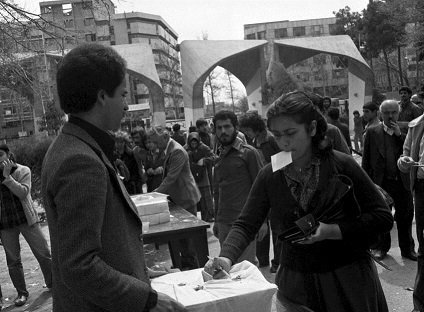
In the official calendar of the Islamic Republic, April 1 marks the day the “system” was consolidated. But in Iran’s critical memory, this date is not simply the anniversary of a referendum. It is the anniversary of the moment when a mass, diverse, anti-despotic revolution was compressed into a single, pre-directed answer: “Islamic Republic, yes or no?” This referendum was held over two days, and its result was announced very quickly, one day later, on April 1, 1979, as the formal establishment of the Islamic Republic. The 1979 revolution was a broad coalition of very different forces, from the secular left to the clergy and nationalists. After the new system was established, their bloody elimination began rapidly.
Today, as the war by Israel and the United States against Iran has entered its fifth week, with the country’s infrastructure from defense sites to steel plants, educational institutions, and pharmaceutical centers under attack, with thousands killed and millions displaced, revisiting that historical moment has become even more important. The value of revisiting it lies in this: it shows that from the very beginning, at the very moment when many were still intoxicated with victory, a voice from within the revolutionary atmosphere itself warned that the fall of the monarchy did not automatically mean the rule of the people.
Your support helps keep this space alive but also ensures that these critical discussions remain accessible to all.
A Referendum That Not Everyone Accepted
In the official narrative, the April 1 referendum is usually reconstructed as the unified will of the “Iranian nation,” as if all anti-Shah forces naturally and immediately lined up behind the formula of the “Islamic Republic” after the fall of the monarchy. But the real history was far more tense. From the start, opposition to the referendum, or to the way it was framed, was not limited to Mostafa Rahimi. Parts of the left, democratic forces, and some organizations from oppressed national groups objected not only to the content of the “Islamic Republic,” but to the very form of the referendum itself: the fact that a vague, rushed, single-option question had replaced free debate about the shape of the future order.
Among those who opposed or boycotted it were groups such as the National Democratic Front and the Organization of Iranian People’s Fedai Guerrillas. Even forces that were not necessarily moving from the same political position protested what they called “Khomeini’s imposed choice.” This split shows that from the very first moment, the main conflict was not simply between monarchy and “Islam.” It was about whether the revolution would open the way to popular self-determination, or be sealed inside an ideological framework.
This reality was even clearer in Iran’s peripheral regions. In Iranian Kurdistan and Turkmen Sahra, the referendum was neither fully carried out nor did it enjoy the legitimacy that the country’s political center wanted to project. In Kurdistan, opposition to the referendum was not just a verbal disagreement over the title “Islamic Republic.” It was tied to a real experience of self-organization, councils, demands for autonomy, and a deep distrust of a state that, before it was even fully established, already carried within it the logic of centralization and subordination.
Academic studies also make clear that Kurdistan and Turkmen Sahra were among the regions where, because of opposition to the referendum and ongoing political conflict, the voting process did not proceed fully or normally. So in these regions, “no” was not simply a negative vote. It was another name for the demand that the revolution should not mean only a change in the command center in Tehran, but should open the possibility of real participation by different peoples, languages, identities, and political forces in shaping the future.
A Document of Early Warning
Mostafa Rahimi’s letter to Khomeini, written on December 31, 1978, is one of the most important documents of this warning. This letter should not be read merely as a “predictive” text, as if its value lies only in the fact that later events proved the author right. Such a reading reduces the letter to a moral document, while Rahimi in fact offers something much more: a fundamental critique of the seizure of the revolution, a clear defense of the unconditional sovereignty of the people, and an attempt to rescue the link between freedom, socialism, ethics, and spirituality from the grip of an ideological state. Published versions of the letter show that Rahimi, while openly anti-Shah, anti-imperialist, anti-Zionist, and at the same time critical of both the Soviet Union and China, confronted the very concept of the “Islamic Republic” itself. He did so not from loyalty to the old order, but from the standpoint of a different emancipatory horizon.
The decisive point in Rahimi’s argument is that he does not see the revolution as the private property of any class, profession, or ideology. He reminds us that a revolution built with the blood of many different groups, with the suffering of political prisoners, with the struggles of intellectuals, students, workers, and many kinds of opponents, cannot at the moment of founding a new order be registered in the name of one specific reading of society and history. The issue here is not only opposition to religious government. The deeper issue is the defense of a principle: that the public sphere cannot be turned into the exclusive property of one political force, even if that force played a major role in overthrowing the previous regime.
In fact, Rahimi’s letter is an early attack on the very logic that later became the foundation of the Islamic Republic: the idea that revolutionary legitimacy can replace democratic participation; the idea that because a leader succeeded in mobilizing people against despotism, he can therefore also determine the future shape of power. Rahimi stands firmly against precisely this leap. He says that the struggle against tyranny is not a license to establish another form of guardianship. The one who saves a house from a thief does not become the owner of the house.
The political value of the letter lies exactly here: it sees the April 1 referendum not as a natural ritual of transition, but as a mechanism for compressing and closing politics. The referendum on the “Islamic Republic” was held at a time when no new constitution had yet been formed, no real freedom of public debate existed, not all political forces had the ability to organize and campaign freely, and even the term “Islamic Republic” itself did not yet have one clear and shared meaning for society. This ambiguity, in Rahimi’s view, was part of the problem. People were being asked to vote for something that, on one hand, was wrapped in the emotional energy of the revolution, and on the other hand remained institutionally and legally lost in the fog. Even non-Iranian historical accounts confirm that some political forces objected to the referendum or boycotted it for exactly this reason.
This point still matters today: voting is not always the same thing as democracy. Sometimes a referendum, especially when its question is single-choice, vague, rushed, and soaked in the emotional heat of revolutionary mobilization, looks more like an oath of loyalty than an act of popular sovereignty. Democracy is not just a ballot box. Democracy means time, awareness, free conflict, organized pluralism, the possibility of opposition, and the real right of society to hear different alternatives. Rahimi understood this in the winter of 1978, before the machinery of exclusion had fully gone into motion.
The Issue Is Not Intention, but Institution
There is another knot in this letter that sets it apart from many later critiques. Rahimi does not reject the clergy as a force of mobilization against the Shah. He even points to its moral and protest role. But from that very point, he reaches the opposite conclusion: if the clergy is a bearer of spirituality and protest, then it should not contaminate itself with political power. This is perhaps the most radical part of the letter. In a world where many were still captivated by Khomeini’s revolutionary charisma, Rahimi raised the central question not about intention, but about institution. He argues that the problem is not only who governs. The problem is that whenever power is separated from society and concentrated in the hands of one group, even the purest actors are changed by its corrupting and exclusionary machinery.
Rahimi’s letter can in fact be read as a deep critique of the twentieth-century illusion of “benevolent power.” He refers to historical examples to show that the good intentions of leaders are no guarantee of freedom. This argument is especially important for modern Iranian history, because one of the main tragedies after the revolution was that a large part of society, and even part of the political opposition, confused the question of power with the question of a leader’s honesty or the purity of an ideology. Rahimi, by contrast, insists on structure, accountability, the right to dissent, and popular sovereignty.
That is why his letter should be seen as the document of a defeated possibility. This text is not only a warning about the future of the Islamic Republic. It records another path, one that could have stood against both monarchy and theocracy. A path that said the revolution should lead to an unconditional republic, freedom of speech, the participation of all social forces in drafting the constitution, and a link between social justice and popular rule. In other words, the failure was not only that the Islamic Republic was established. The greater failure was that the very idea of a “people’s republic” was suffocated at the very starting point.
Today, as Iran is under the fire of two powerful hostile forces, returning to this letter is not an act of nostalgia. The point is not to look back at the past with regret. The point is that, at a moment when the danger once again exists of erasing Iranian society from the political stage, we must insist on the same simple but decisive principle: neither American and Israeli bombers represent freedom, nor does a religious state represent the people. If anything is to emerge from this dark history, its name must be the same thing Rahimi demanded on the eve of revolutionary victory: the sovereignty of the people, without any conditions.


Overall good essay. Very valuable for THIS historical moment.
Be careful. A people\’s republic is not rushed or stillborn. Its a contradiction in terms that shouldn\’t be encouraged. A minority rule of specialists and elites can never be directly controlled by the popular majority.
Recently I was reading Ernest Renan. He basically said: whether a society is organized with fair referendums on every crucial question or not, every day we wake up we informally decide to accept or reject the dominant order by how we think and how we act.
In my forthcoming book CLR James\’s discourse on the \’seizure of power\’ is not focused on a coup. Rather, he encourages discussions in popular assemblies about the type of government we want and do not want. Once this consensus is established a further battle for democracy can be pushed forward in various ways with militias for civil defense and aspirations to split the police and army.
Iran and the world need more conversations like the one you ate encouraging, out of crisis what will be the terms of transition? You are right to be on guard against decisions being thrust upon the populace.