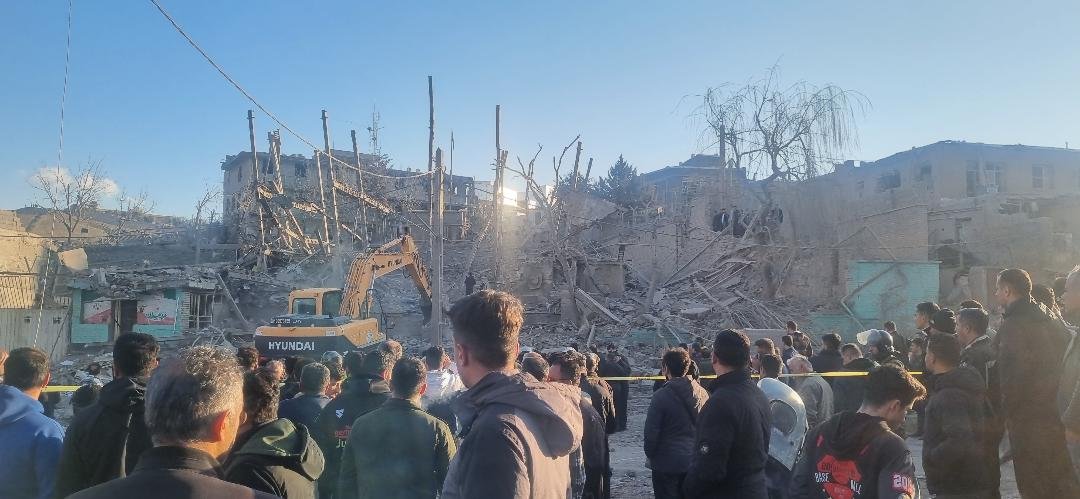
As the United States and Israel attacks on Iran enters a more sensitive phase, the Cooperation Council of Left and Communist Forces in Kurdistan have issued a joint statement warning about the danger of Kurdistan becoming the main center of war, destruction, and displacement.
In this statement, the cooperation council said that the continued US and Israeli attacks on the Iran’s military and security centers in the border cities of Kurdistan, together with the placement of regime forces and bases inside residential areas, has created a major danger for ordinary people.
Your support helps keep this space alive but also ensures that these critical discussions remain accessible to all.
The statement says that by refusing to evacuate its military and security centers from urban areas, and even by housing its forces in schools, mosques, dormitories, and public buildings, the Islamic Republic has in practice turned civilians into human shields. According to the signatories, this situation has forced many residents of towns and villages across Kurdistan to leave their homes in order to protect their lives.
But the main warning in the statement is about another scenario: the ground entry of an alliance of six Kurdish nationalist parties and currents into the war against the Islamic Republic, in coordination with the United States and Israel.
Referring to reports about recent political contacts and discussions of a ground offensive from Kurdistan, the cooperation council warn that such a path could turn the cities of Kurdistan into a direct battlefield and push the region toward large-scale destruction.
In their view, if the war becomes prolonged, the United States and Israel may use the armed forces of these parties as infantry in their war. This, they argue, would not only go against the interests of the people of Kurdistan, but could also give the Islamic Republic even more room to bring heavier fire onto the region.
Against this perspective, the cooperation council put forward another path: strengthening popular solidarity, creating neighborhood committees, local councils, aid groups, and self-organized structures to reduce the human costs of the war and to prepare for council-based administration as state control weakens.
They also once again stress the role of the working class and nationwide strikes in key sectors of production and services as a decisive force for putting pressure on the Islamic Republic and stopping its machinery of war and repression.
In the continuation of this debates, Komala’s leadership committee, in a separate letter addressed to a group of Kurdish political activists abroad, also explained why it did not join the “alliance” of Kurdish parties.
In this letter, while defending the principle of dialogue and civilized relations among Kurdistan’s political forces, Komala argues that real political unity cannot be built by ignoring serious differences in program, strategy, and political horizon.
In the letter, Komala makes several central lines of disagreement clear: its emphasis on the natural connection between the struggle of the people of Kurdistan and the broader movement of workers and the oppressed across Iran; its opposition to aligning with US and Israeli policies; its opposition to right-wing and monarchist opposition forces; and its rejection of any strategic closeness to the MEK.
In Komala’s view, the alliance document is not clear on these issues, and that ambiguity could lead to crisis and collapse at critical political moments.
Another major point in the letter is the question of armed force. Komala stresses that after any future political change in Kurdistan, weapons should not remain in the hands of party organizations, but should be transferred, through a limited and clearly defined process, to democratically chosen popular institutions.
The organization warns that any project for creating a unified armed force, without clearly defined democratic and popular control over it, could in practice become a new source of conflict and crisis.
In the final part of the letter, Komala points to a new factor that, in its view, makes all of these disagreements even more important: official US contact with armed Iranian Kurdish groups and with the ruling forces in the Kurdistan Region, aimed at drawing them into ground military operations against the Islamic Republic.
Referring to media reports, Komala describes this policy as an attempt by the United States to use Kurdish forces in service of its own goals, and warns that, as the experience of Rojava showed, such alliances can be abandoned once they have been used.
In Komala’s view, tying the fate of the just struggle of the people of Kurdistan to US strategy is not a path to liberation, but the beginning of a political and social disaster.