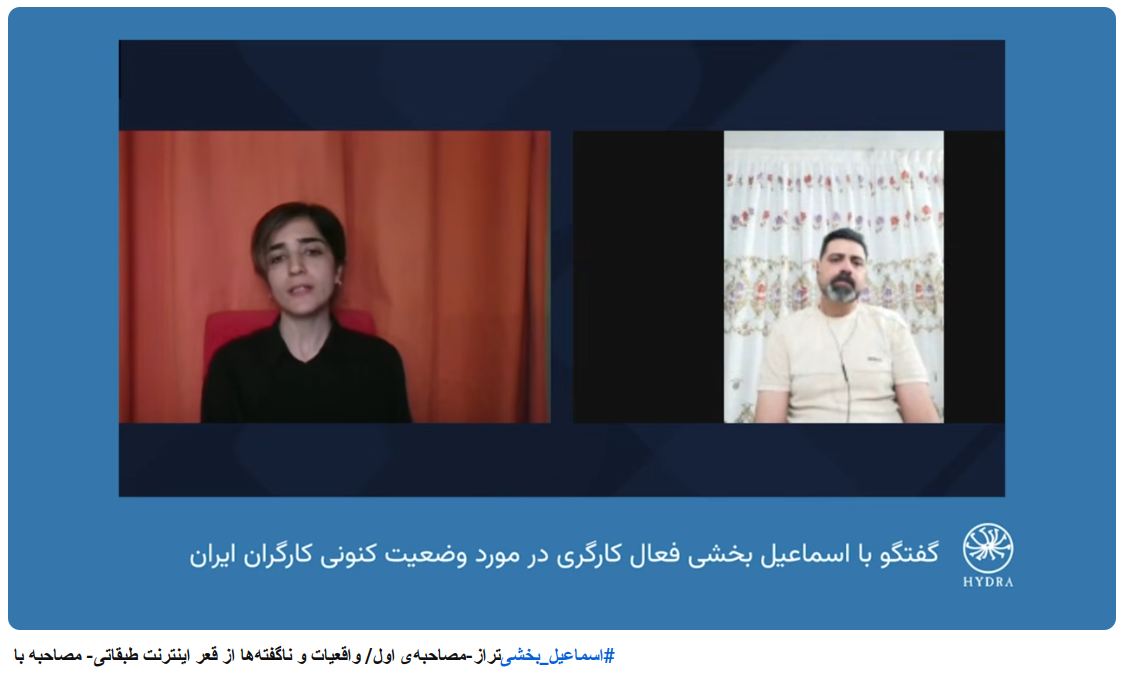
Esmail Bakhshi, the well-known Haft Tappeh worker and labour activist, begins his May Day conversation from a point that may sound technical at first: the internet. But very quickly, this becomes one of the clearest signs of today’s Iran. He explains that just to join a simple online conversation, he had to rely on friends, a VPN, technical configurations, a lot of effort, and a high cost. According to him, nearly two million tomans were spent only to make this one call possible.
This is not just a story about filtering. From this point, Bakhshi moves to a much deeper issue: the class-based nature of internet access in Iran. Something that should be available to everyone, like water, electricity, communication, and public information, has now become a privilege for those who have money, connections, technical tools, and special access. The internet, which could have been a tool for dialogue, organising, information, and social connection, has itself become part of class inequality.
In this situation, workers, teachers, nurses, retirees, prisoners’ families, protesters, and poor wage-earners are not only pushed out of the streets and workplaces. They are also pushed out of the space of communication. Imposed silence is not created only with batons and prisons. It is also created by cutting people off, making access expensive, filtering, and turning the internet into a luxury product.
The Collapse of Old Class Boundaries
From here, Bakhshi moves to the wider condition of society. He says that in today’s Iran, almost anyone who lives on wages or a salary has effectively been pushed into the lower class. This is not just a description of poverty. It is a description of the collapse of old class boundaries. In an economy where inflation, unemployment, war, repression, and instability have swallowed everyday life, it is no longer only the factory worker who is pushed down. Teachers, nurses, office workers, retirees, shop assistants, contract workers, students, and low-income families are all trapped in the same field of pressure.
But for Bakhshi, the issue is not only livelihood. He calls war “absolute evil”. In his view, every suffering that already existed in Iranian society before the war has been multiplied by the war. There was already high prices, inflation, unemployment, lack of money, shortages of medicine, and lack of freedom. But war has intensified all of them. He says war multiplies suffering ten times, sometimes a hundred times. This view is both anti-war and against simplification. Because Bakhshi is not saying life was good before the war. On the contrary, he stresses that people were already under pressure before the war, but war has pushed that pressure into a new level of disaster.
Here his criticism works in two directions. On one side, he attacks those who decorate bombing and war with phrases such as “humanitarian intervention”. On the other side, he does not let the Islamic Republic and its domestic war supporters off the hook either. In his words, the government loved war for years. Now war has arrived, the streets have been turned into scenes of flags and state performance, but the people have been left alone with inflation, unemployment, loss of income, and helplessness.
In Bakhshi’s picture, war is not only missiles and bombs. War means the shutdown of major factories. It means the collapse of work chains. It means thousands of contract and project workers losing their jobs. It means prices rising from one moment to the next. It means people living without knowing what will happen tomorrow to their bread, medicine, rent, or job. When large factories, steel plants, mother industries, or production centres are damaged or shut down, it is not only one economic unit that stops. Dozens and hundreds of contract, service, and dependent companies also fall with it. In this structure, war begins from above, but its cost settles at the very bottom of society.
The Danger of Political Appropriation
Still, the most important part of Bakhshi’s words comes when he talks about the experience of protests, strikes, and political appropriation. He says that if workers are not independent, the same thing happens that happened in Dey (January protest): people come into the streets because of economic pressure, suffering, lack of rights, and social anger, but political forces outside the real body of society try to take over their movement. The result is that people are sent in front of bullets, they pay the price, they are killed, arrested, and executed, while those who registered the slogans in their own name are never held accountable.
This criticism is not aimed at only one specific group. Bakhshi speaks about an “appropriating opposition”; individuals, groups, and media outlets that present people’s protests as part of their own projects. He says clearly that in today’s Iran, there is no individual and no group for whom people are ready to sacrifice their lives. If people come into the streets, they do so because of their own suffering; because of poverty, repression, lack of a future, lack of rights, and the freedoms taken away from them.
This sentence has serious political importance. With it, Bakhshi challenges both the illusion of leader-making and the fantasy of “sacrificing lives” for political figures and projects. He says today is the age of life, the age of lived experience, the age of defending human life and dignity. No one should sacrifice their life for an individual or a group that is not accountable, does not pay the price on the ground, and cannot even build a basic infrastructure such as free internet access for people.
But Bakhshi does not stop at criticism. He sees the way forward in independent organising, associations, representation, and strikes. In his view, protest without organisation, no matter how large it is, remains vulnerable. A strike without representatives, without clear demands, without an independent language, and without coordination can easily be appropriated. He calls on workers, teachers, nurses, students, bazaar workers, oil workers, steel workers, sugarcane workers, miners, and all wage-earners to choose representatives from among themselves before any protest, list their demands clearly, and use slogans in a way that no one can take over their movement.
Here Bakhshi emphasises peaceful strike action, but he knows this phrase can be misunderstood. For him, being peaceful does not mean reformism, passive waiting, or begging power for mercy. It means workers recognising their main source of power: stopping work. He says we do not have weapons, and we do not want to have them. Our power is the strike. Our power is stopping work. Our power is collective organising. This politics is neither compromising nor adventurous. It is a politics that understands where the working class’s real power lies.
He recalls the experience of Haft Tappeh as a more successful example. In his view, the media and social support around Haft Tappeh worked because the workers had their own organisation, representatives, and independent voice, and because they did not allow their movement to be easily taken over. This is the lesson Bakhshi wants to extend from Haft Tappeh to society as a whole: if a protest does not have organisation, others will build an organisation for it; if it does not have its own language, others will speak in its place; if it does not have its own representatives, others will pretend to represent it.
The Workers’ Question Will Not Disappear After the Islamic Republic
Another important part of Bakhshi’s argument is his view of the future. He warns that even if the Islamic Republic leaves power today, the workers’ question will not be solved. Whoever comes after it will still need workers to rebuild Iran. Once again, workers may be told to wait: first reconstruction, first rebuilding, first the national interest, first saving the country. This is the same old story. That is why workers must begin now to turn their gains into law, build their independent organisations, unions, and councils, and create strong guarantees for the enforcement of their rights.
This view saves workers’ politics from becoming a follower of other forces. Workers should not wait for a government, a leader, an opposition group, or a rescue project to arrive and bring them their rights. Rights must be organised. Demands must be shaped. Protest must gain memory and structure. Strikes must have representatives. Independence must become a public political language.
At the end of the conversation, Bakhshi treats May Day not as a simple celebration, but as a reminder of the history of workers’ struggle. He says this is the day of workers who came into the streets to change laws in favour of the working class, and who were repressed and shot. So for him, May Day is not a decorative occasion. It is a reminder that no right has ever been won without collective struggle.
But perhaps the bitterest and most precise part of his words is where he speaks about the distance between “the surface of the city” and “beneath the surface of the city”. On the surface, there may be flags, performances, slogans, normalisation, and official images. But beneath the surface, he says, disaster is taking place: unemployment, loss of income, lack of money, desperation, social rupture, and the psychological collapse of human beings.
This is the image of Iran today. A country where war, repression, poverty, disconnection, state propaganda, opposition appropriation, and social exhaustion are all working at the same time. In such a situation, Bakhshi’s words become important: no surrender, no sacrificing lives for others, no being appropriated, no hope in war, no following internal or external powers. The road, if there is still a road, passes through workers’ independence, social organising, strikes, representation, associations, and the defence of life.
In these conditions, May Day is not just a date on the calendar. It is a reminder that society, even in its darkest moments, can still organise itself from below. But only if it does not hand over its own voice to someone else.


