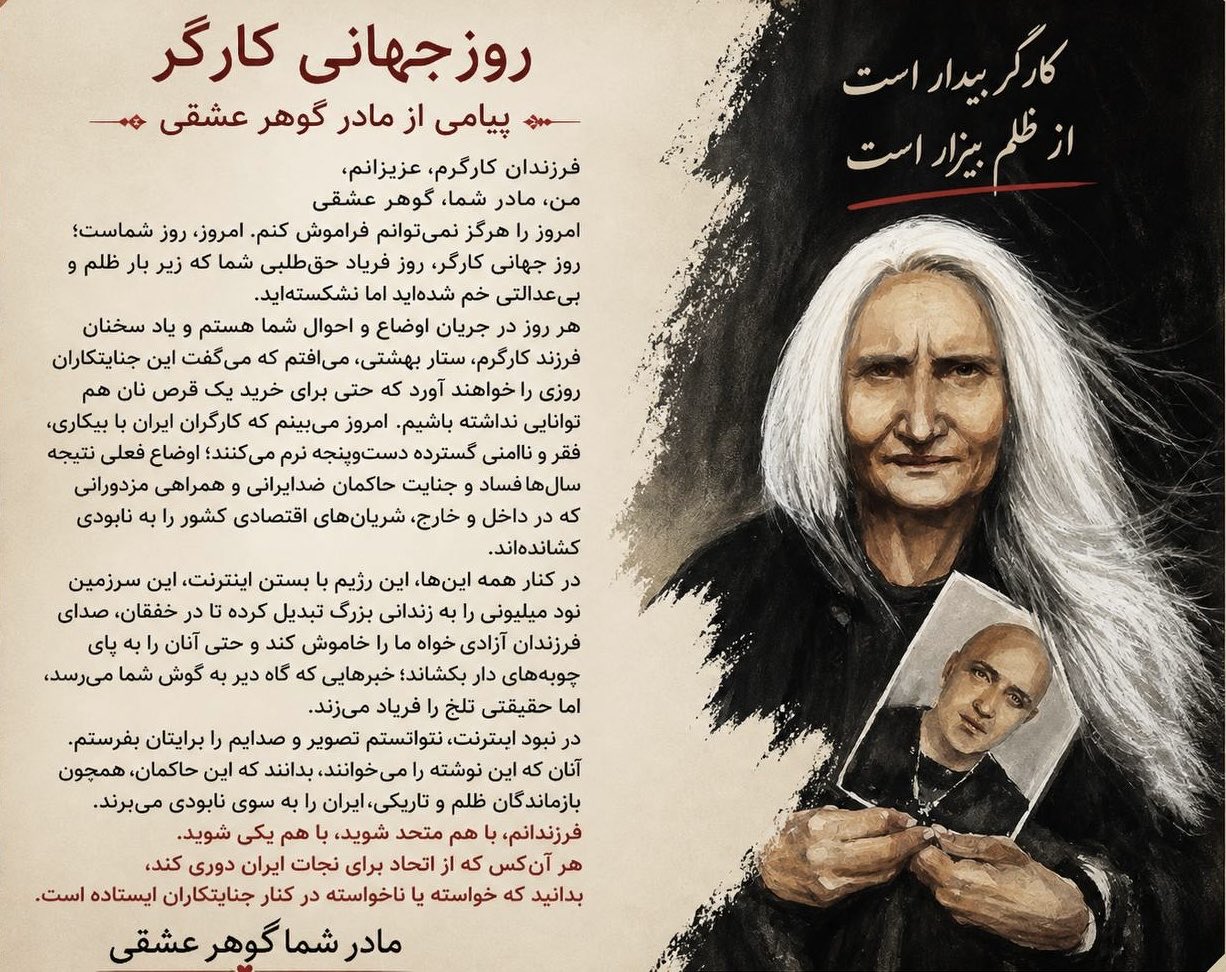
On International Workers’ Day, Goahar Eshghi, the mother of Sattar Beheshti, published a message addressed to workers in Iran. It is a short text, but it carries the weight of a whole political history: the history of a worker killed in custody, a mother turned into a public voice of justice, and a society where labor, poverty, censorship, and state violence are tied together.
Sattar Beheshti was a 35-year-old worker and blogger from Robat Karim, near Tehran. He was arrested on 30 October 2012 by Iran’s cyber police, known as FATA, after writing critical posts online. A few days later, on 3 November 2012, he died in custody. His family was informed only afterward and was told to collect his body. Prisoners who had briefly seen him in Ward 350 of Evin Prison later said there were signs of torture on his body. Before his death, Sattar had reportedly written a complaint saying he had been beaten during interrogation.
Your support helps keep this space alive but also ensures that these critical discussions remain accessible to all.
The official handling of the case followed a familiar pattern: denial, delay, limited admission, and finally a narrow legal punishment that avoided confronting the system itself. One police officer was later sentenced, but the case was reduced from what the family and many human rights groups considered torture leading to death into a much smaller legal matter. The state tried to turn a political crime into an individual excess. But Sattar’s death could not be contained in a court file.
Goahar Eshghi refused to let it disappear.
In her Workers’ Day message, she begins not from abstract politics, but from class position: “My worker children, my dears, I, your mother, Goahar Eshghi, can never forget this day.” She calls International Workers’ Day “your day,” the day of those who have carried “the burden of oppression and injustice” but have not been broken.
This is important. She does not speak about workers as a symbolic mass. She speaks to them as people whose lives she recognizes. She connects Sattar’s life and death to their condition. Sattar was not a famous intellectual, not a party leader, not a member of an elite opposition circle. He was a worker who wrote online. That combination itself explains why his case matters so much. The Islamic Republic did not only target a political activist. It targeted a working-class citizen who used the internet to speak.
Goahar writes that she remembers Sattar saying these criminals would bring the country to a point where people “would not even be able to buy a loaf of bread.” In her message, this memory becomes a political diagnosis. She links today’s unemployment, poverty, insecurity, and collapsing livelihoods to “years of corruption and crime” by those in power and to their “betrayal and collaboration” in destroying the country’s economic arteries.
The sentence matters because it refuses to separate political repression from economic destruction. Sattar’s death was not only about freedom of expression. It was also about the kind of society in which a worker’s voice becomes dangerous because it exposes the connection between poverty and power. A regime that beats a worker-blogger to death is also a regime that fears workers as thinking political subjects.
Another central part of Goahar’s message is about the internet shutdown. She writes that the regime, by cutting the internet, has turned a country of nearly ninety million people into “a large prison” in order to silence the voices of freedom-seeking sons and daughters. This point is not just about technology. In Iran, internet control is part of the machinery of rule. It blocks documentation, interrupts organization, isolates families, hides repression, and makes social life dependent on state permission.
Sattar Beheshti’s case was one of the early symbols of this machinery. He was arrested by the cyber police because of what he wrote online. More than a decade later, Goahar Eshghi is still speaking about the same structure: the state fears connection, speech, memory, and the ordinary act of people finding each other.


Her message also contains a warning. She writes that in the absence of the internet, she could not share her image and voice with workers, but she knows that those reading her words understand that the rulers, “like survivors of darkness and oppression,” are taking Iran toward destruction. Then she directly addresses workers: “My children, unite, become one.” And she adds a sharp political line: anyone who distances people from unity for the rescue of Iran should know that, knowingly or unknowingly, they are standing beside the criminals.
This is not a sentimental appeal. It is a political argument about fragmentation. The ruling order survives not only through police, prison, censorship, and executions, but also through isolation. Workers are separated from students, families of victims from labor struggles, women’s movements from economic demands, ethnic and regional struggles from national politics, and online voices from street organization. Goahar’s message tries to cut across these separations.
That is why Sattar Beheshti remains politically alive. His case is not only a memory of state violence in 2012. It is a method for reading Iran today. A worker writes. The cyber police arrest him. He dies under custody. His mother refuses silence. The state tries to reduce the crime. The mother expands it again into a question of society: who has the right to speak, who pays the price of poverty, who is protected by law, and who is crushed by it?
Her Workers’ Day message makes one thing clear: Sattar’s case cannot be separated from labor. He was a worker killed after speaking. His mother addresses workers because she knows the same system that killed him also produces unpaid wages, insecure contracts, unemployment, corruption, censorship, and fear. The violence that enters the interrogation room is connected to the violence that enters the factory, the household, the school, the street, and the phone screen.
This is why the sentence written beside her image is so precise: “The worker is awake, disgusted by oppression.” It is not a slogan about inevitable victory. It is a statement about consciousness. A worker who understands the link between bread, speech, prison, internet shutdown, and state power is no longer just a victim of economic policy. He or she becomes a political subject.
Sattar Beheshti was killed because a worker spoke. Goahar Eshghi continues to speak because the state failed to make that death silent. On Workers’ Day, her message is not only a memorial for her son. It is an indictment of a system that fears workers when they write, when they organize, when they remember, and when they refuse to stand alone.


