Internet access across Iran remains severely disrupted as the war enters its fifth day, limiting independent reporting and leaving much of the public reliant on state-linked outlets, scattered eyewitness posts, and occasional footage transmitted via satellite connections. Network monitoring group NetBlocks has reported major connectivity drops, including near-total disruption during parts of the escalation.
Your support helps keep this space alive but also ensures that these critical discussions remain accessible to all.
With connectivity down or inconsistent in multiple provinces, information has become fragmented and difficult to verify in real time. The Guardian, citing digital rights experts, has described the current blackout as part infrastructure impact and part deliberate shutdown intended to isolate the public, restrict coordination, and shape the narrative under wartime conditions.
At the same time, cyber operations have intensified. Reuters reported a wave of hacks and disruptions affecting Iranian apps and websites following the initial U.S.-Israeli strikes, alongside signs of broader cyber pressure on communications and online services.
Iranian domestic news agencies have continued publishing frequent updates through Telegram and social media, heavily emphasizing retaliatory actions and official statements. The overall effect has been a tightly managed information environment: a mix of outages, state messaging, and uneven, hard-to-confirm eyewitness reporting.
Tehran: strikes, disruption, and fear
Reports from Tehran point to airstrikes hitting a mix of security-linked facilities, government buildings, and surrounding urban areas. Associated Press reporting on the fifth day of war described ongoing strikes and explosions in Tehran alongside continuing regional escalation.
Reuters, citing interviews with residents, described a city gripped by fear, with heavy security presence, damaged infrastructure, and sporadic internet access. The same Reuters report said there were no clear signs of large-scale street protests despite external expectations that the war could trigger an uprising.
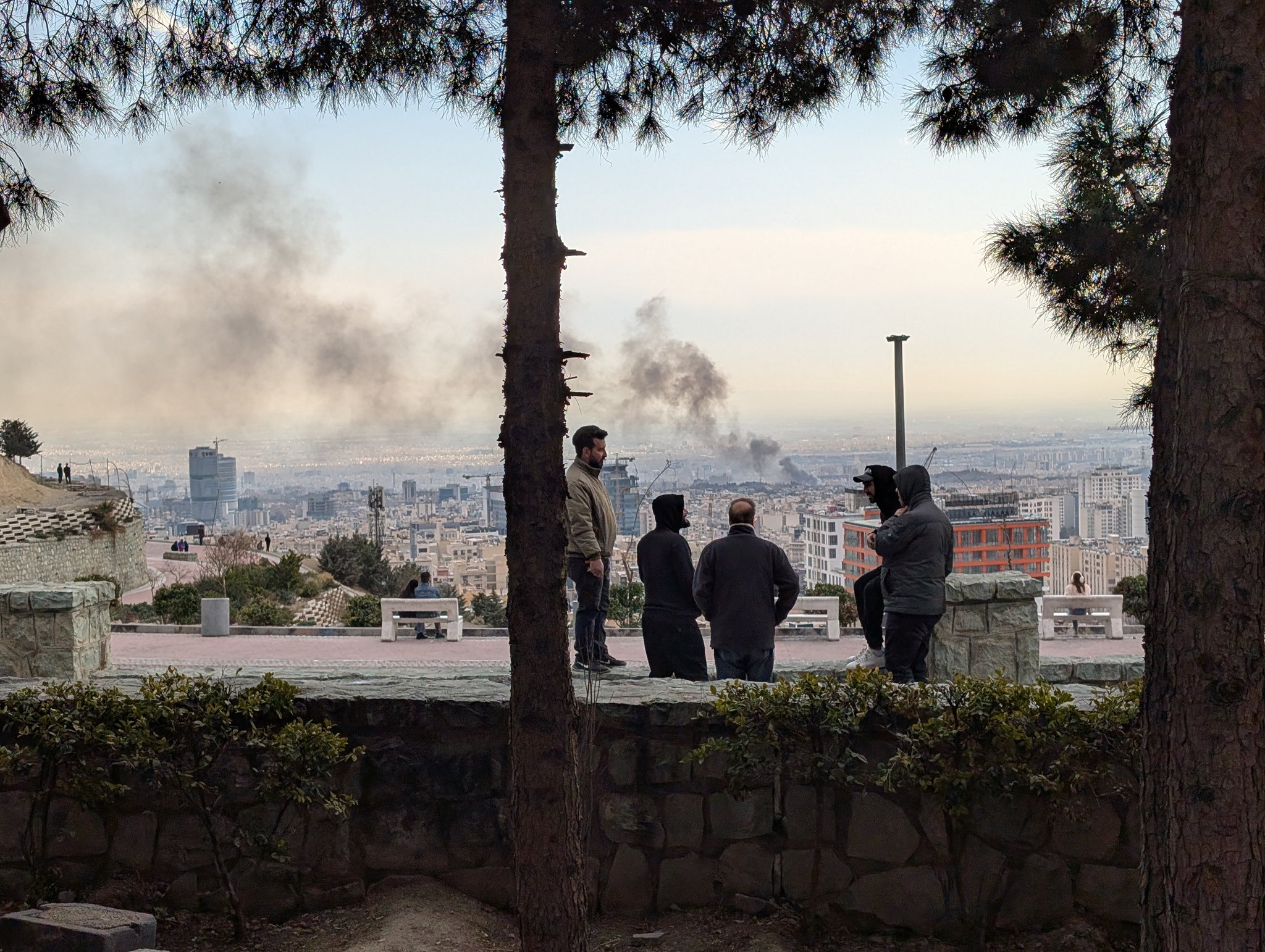
Eyewitness accounts posted on X (formerly Twitter) — where connectivity allows — describe disrupted daily life: shuttered shops (especially those selling perishable goods), intermittent electricity outages in some districts, and a noticeable drop in street activity compared with earlier days. These claims remain difficult to independently confirm under current conditions, but they align with broader reporting on infrastructure stress and public anxiety.
Official warnings and the threat of rapid punishment
Alongside the military escalation, concerns are rising about intensified domestic repression. Reuters reported days earlier that the UN High Commissioner for Human Rights warned of a growing risk of executions tied to January’s protests and urged a moratorium on the death penalty — a warning that now intersects with wartime rhetoric and “security” framing inside Iran.
Separately, reports circulating in regional media cite statements attributed to Iran’s judiciary chief describing the country as being “in a state of war” and threatening decisive punishment for actions deemed aligned with the “enemy.” Because direct access to Iranian state broadcasts is limited for many observers during blackouts, these claims should be treated cautiously unless corroborated through primary-state transcripts.
Prisons under stress: transfers, shortages, and fears of a humanitarian crisis
One of the most urgent human-rights concerns emerging from the conflict is the situation inside Iran’s prisons. Multiple reports indicate transfers of detainees to undisclosed locations, disrupted access to food, water, and medical care, and rising fear of rushed prosecutions or executions under wartime conditions.
A recent alert from Worker-Communist Party of Iran warned that political prisoners are at heightened risk amid airstrikes and instability, including reported damage at facilities such as Fashafuyeh and concerns about conditions deteriorating rapidly.
Additional reporting by X users has circulated that Ward 209 — widely associated with high-security detention — was evacuated and prisoners transferred to an unknown location, while other prisoners remained elsewhere in the complex.
These developments revive memories of prior wartime prison crises. In 2025, Amnesty International and Human Rights Watch warned that airstrikes on Evin put detainees at serious risk and described the aftermath as involving transfers, concealment of whereabouts, and conditions amounting to cruel and inhuman treatment. While the current conflict differs, the historical record underscores a consistent vulnerability: prisoners often become invisible casualties of war and repression combined.
Regional and global spillover: oil, shipping, and aviation disruptions
Beyond Iran, the conflict is generating immediate economic and logistical shockwaves. Reuters reported oil prices rising amid fears of prolonged disruption, with attention focused on supply risks and instability across West Asia’s energy infrastructure and shipping routes.
Commercial aviation has also been thrown into chaos. The Guardian reported major Persian Gulf carriers suspending flights and tens of thousands of cancellations, with airspace closures and rerouting constraints affecting over a million passengers.
What can be verified — and what cannot
Because internet access is severely restricted and movement is constrained, independent verification is uneven. The most reliable picture currently comes from a combination of (1) major wire services reporting from interviews and official statements, (2) network monitoring data, and (3) human-rights documentation that aggregates reports and flags what remains unverified. NetBlocks’ real-time metrics support claims of major connectivity disruption. HRANA has published aggregated casualty figures since February 28, including reported civilian deaths and injuries, while noting verification remains ongoing for parts of the data.
Meanwhile, the situation inside prisons remains one of the least transparent and potentially most dangerous fronts of the crisis — precisely because detainees are cut off, families struggle to obtain information, and wartime conditions can accelerate abuses without scrutiny.
Kurdistan
Over the past 24 hours, Iranian users have published numerous reports on developments in Iran’s Kurdistan region, largely focusing on airstrikes against military sites, armed clashes, unrest inside prisons, and the reported entry of Kurdish opposition groups. The posts describe heightened tensions along border areas and in cities such as Sanandaj, Baneh, Mahabad, Saqqez, and Divandarreh, with repeated references to damage and growing concern over potential civilian casualties.
In Sanandaj, users say strikes on an IRGC base in the Qeshlaq area caused extensive destruction, a high number of injuries, and overcrowding in hospitals. Some accounts also report the transfer of military and security forces to the Hiwalrd complex, while noting that the situation of detainees held in affected facilities remains unclear.


In Baneh, users reported multiple explosions since the morning at the IRGC’s Salehabad garrison and other military locations, describing repeated attacks and direct hits.
In Mahabad, posts say bombing near the prison sparked protests by detainees, which were reportedly met with tear gas. Conditions inside prisons were described as disorderly, with warnings of a potential humanitarian crisis.
Users also reported clashes in Saqqez and Divandarreh, claiming that armed Kurdish groups — described in some posts as separatist — entered the cities, triggering dangerous confrontations.
Separately, some accounts pointed to U.S. and Israeli airstrikes in border areas such as Paveh and Sanandaj, suggesting these operations could be aimed at opening routes for Kurdish opposition forces from the Kurdistan Region of Iraq to enter Iran.
In response, users report that the IRGC has carried out drone attacks on bases linked to Kurdish parties in Koya and other locations in Iraqi Kurdistan, with reports of injuries and visible smoke following explosions.
Reactions online appear divided. Some users frame the reported entry of Kurdish armed groups as a separatist threat and call for clearer information, while others emphasize the bombing of border outposts and the possibility of U.S. backing for opposition forces.
The information cited above is drawn primarily from posts by users based in Iran or connected to the region, and reflects a mix of eyewitness claims, human-rights reporting, and security-related concerns.
Photo source: x.com/HosseinHamdieh