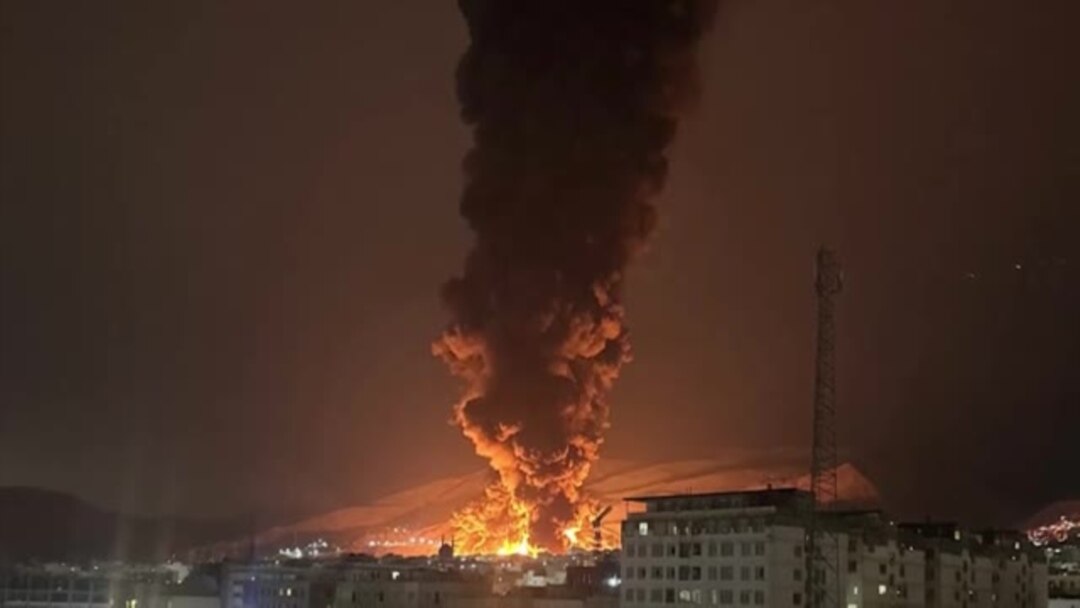
The issue is not simply the bombing of several oil depots. The real issue is that in modern wars, energy infrastructure is no longer just a military target. It has become the point where war, economy, environment, and everyday life intersect. When fuel storage facilities in Tehran, Rey, Shahran, Ghoochak, Fardis, and Alborz are attacked, it is not only gasoline, diesel, or natural gas that burns. The air burns. The soil becomes contaminated. Citizens’ bodies are exposed to toxic particles. For several hours or even days, the city turns into the scene of an undeclared chemical war — a war without formal announcement, but one that can be breathed in.
Two months after the attacks on oil depots in Tehran and Alborz, Shina Ansari, head of Iran’s Department of Environment, described the strikes as an example of “ecocide.” The term refers to severe, widespread, or long-term environmental destruction caused by reckless or unlawful actions. According to her, during the recent war — now tied to a fragile ceasefire — around 368,000 cubic meters of liquid fuel and nearly 199 million cubic meters of natural gas were destroyed through fires and emergency flaring. In other words, an enormous amount of fossil fuel burned within a short period of time, releasing the products of combustion into the country’s atmosphere.
Your support helps keep this space alive but also ensures that these critical discussions remain accessible to all.
On the evening of March 16, the United States and Israel bombed oil depots in Tehran and Alborz. The next morning, Tehran and Karaj woke up beneath a layer of smoke and darkness. For many residents, the immediate question was no longer foreign policy or military balance. The question was whether it was still safe to breathe. Was the air toxic? Would acid rain follow? Would children, the elderly, heart and respiratory patients, and workers forced to leave their homes become the invisible shields of this war?
Eventually, authorities advised people not to leave their homes unless absolutely necessary. Rainfall and strong winds helped disperse part of the pollution. Later, the head of Tehran’s Air Quality Control Company explained that much of the soot had risen into higher atmospheric layers because of the heat generated by the explosions. Due to unstable weather conditions and a high atmospheric mixing layer, no dramatic increase was recorded across all ground-level monitoring stations.
Yet this technical explanation should not hide the central reality: public health was left at the mercy of weather conditions. If the wind had not blown, if the rain had not fallen, or if the atmospheric layer had been lower, what level of pollution would Tehran and Karaj have faced?

This is where the main contradiction appears. Governments, armies, and military alliances justify attacks on fuel infrastructure in the language of security and deterrence. But the real cost settles inside human bodies. Even if military logic describes these strikes as “targeting infrastructure,” they are, in practice, attacks on the conditions necessary for life itself: the air people breathe, the soil that becomes polluted, the water that may be contaminated, and the city that must survive between war and ordinary life.
Iran’s Department of Environment says that after the explosions, temporary increases in hazardous pollutants — including volatile organic compounds — were detected, along with localized oil contamination in soil and airborne particles. However, the full report on these damages has still not been released. That delay is itself part of the problem. A society that has inhaled the pollution has the right to know what entered its air, soil, and bodies. Ecocide is not merely a matter for diplomatic correspondence with international institutions. It is also a question of the public’s right to information, healthcare, legal accountability, and protection.
At the same time, another environmental case has emerged in the Persian Gulf. Images of a large black oil slick near Kharg Island spread rapidly on social media, leading to speculation that Iranian oil facilities had leaked. Iran’s environmental authorities later stated that preliminary investigations suggest the pollution came from contaminated ballast water discharged by a foreign oil tanker, and that no leakage had been reported from Iranian pipelines, terminals, or offshore platforms.
If confirmed, this would reveal another dimension of the same crisis. The Persian Gulf is not only an energy corridor; it is a shared ecological space for millions of people and countless marine species. Yet within the logic of oil, war, shipping, and profit, it is often reduced to a surface where environmental costs can be dumped and hidden.
Iranian environmental officials say they have sent documentation of the war’s ecological damage to the United Nations and international environmental organizations. Civil society groups and environmental NGOs have also written to international bodies. So far, however, there has been no meaningful response.
Still, criticism of ecocide should not remain trapped within the official language of the state. The United States and Israel bear responsibility for attacks whose environmental consequences have directly affected the lives of ordinary people in Iran. But the Islamic Republic cannot hide behind external aggression and reduce the issue to a purely diplomatic matter. A state that has spent decades weakening Iran’s environment through rent-based development, oil dependency, destructive dam projects, privatization of natural resources, repression of environmental activists, and the securitization of public information cannot suddenly present itself only as the defender of nature.
The reality is that foreign war and internal destruction are not separate processes. American and Israeli bombs sent pollution into Tehran’s sky within hours. But years of opaque and security-driven environmental management had already left society vulnerable to exactly this kind of disaster.
If ecocide is to be treated as a serious concept, it must name both military aggression and the public’s right to transparency, healthcare, compensation, and democratic control over vital infrastructure.
The air over Tehran on that dark morning was not only polluted. It was evidence that in oil wars, ordinary people are always on the front line — even when they carry no weapons at all.


