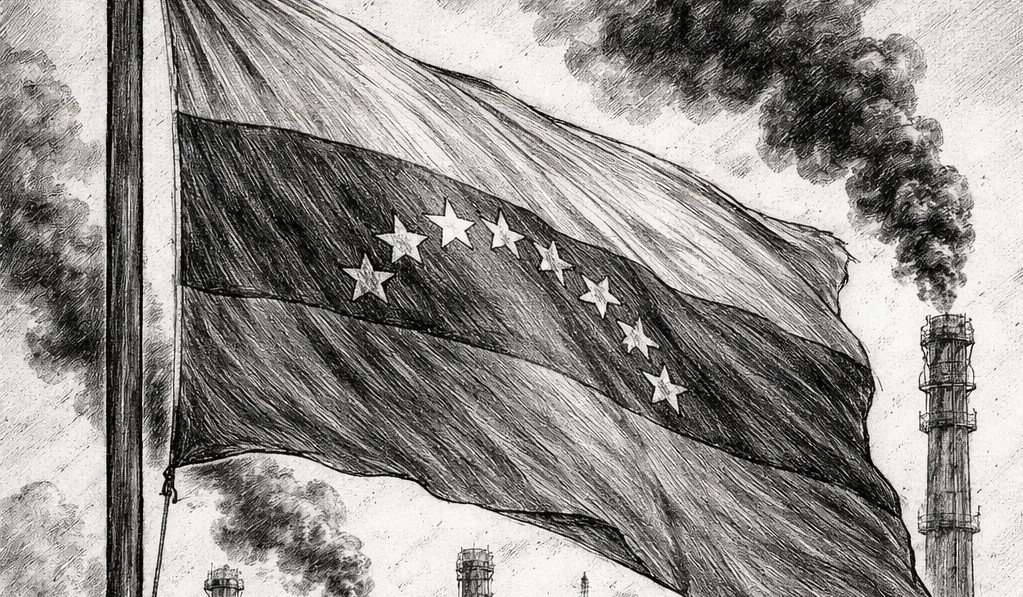
Bernie Sanders and Alexandria Ocasio-Cortez, with the way they frame this, are shrinking the historical reality of our moment. The issue today is not simply a few “misconduct” cases or the “illegality” of certain U.S. executive actions, and it can’t even be reduced to “oil” in the crude, literal sense. The real issue is a project to rebuild American political hegemony on a global scale. What we are witnessing is a deliberate return to the playbook of the 1960s and 1970s: a project aimed at redividing the world, redefining spheres of influence, and reorganising the order of power.
Reducing this blunt reality to a handful of legal disputes or a few instances of presidential overreach is, in itself, a political distortion. If you measure military action or foreign intervention only by the yardstick of “Congressional authorisation” or “violations of the law,” you miss the deeper question: what exactly is this state trying to rebuild, and which relationships of power is it trying to stabilise again? You could see the same pattern recently in the way some U.S. politicians reacted to Washington’s actions in Venezuela: they narrowed the whole discussion to a legal argument about executive authority, while critics warned that the path smelled like regime change and oil interests. But even if we assume oil is part of the motive, oil is just a code word for something bigger: a reshuffling of power.
If China has expanded its influence in Africa through massive spending, lending, and trapping states in cycles of debt; if Russia is waging war against Ukraine to control energy corridors and transit routes into Europe; then the United States is acting by the very same logic of power: trying to return to its previous hegemonic position, or at least preventing a stable multipolar order in which Washington is no longer the final rule-maker. This is not an exception, and it is not a deviation. It is the normal logic of the global capitalist order, reproduced in different forms.
This is exactly where we run into the classic mindset of the “neoliberalised left.” Inside the United States, the crisis is reduced to a few violations, a few instances of lawbreaking, or a handful of limited reforms—as if making the process “legal” automatically means power itself has been restrained. But the U.S. political system only allows change within a very tightly controlled framework. Zohran Mamdani’s victory in New York, with all its symbolic and political weight, proves that cracks exist: you can win, you can mobilise, you can push back against urban oligarchies. But none of this is decisive or sufficient on its own. If the underlying power relations are not shaken, these gains are quickly absorbed into the system’s own logic, or neutralised through administrative, judicial, and media coalitions. Mamdani is the mayor of New York today, and Sanders and Ocasio-Cortez are standing with him—but the real question is whether this win can become a lasting shift in the balance of forces, or whether it will dissolve inside the same urban-financial machinery that has always swallowed reforms.
Outside the United States, this distortion becomes even deeper. The same intellectual currents that, at home, strike an anti-corruption moral pose and limit the debate to legal procedures, show up internationally with vague “anti-imperialist” slogans—without any serious analysis of capital, state power, and global hegemony. The result is a double standard: in Washington, everything becomes a “violation of the law” that can supposedly be fixed through oversight and reform; in the wider world, everything becomes “defending nations,” covered up with moral posturing. This double standard is neither accidental nor innocent. It has a function: to hide the reality of political power and push class contradictions to the margins on a global scale.
In this framework, the truth that should be kept in full view is deliberately removed: capital is not just markets and companies. Capital is organised political power. Hegemony means the ability to set the world’s agenda—to decide what counts as “legitimate,” what is “illegal,” what is “security,” what is “terrorism,” and who has the right to use force and who does not. When a hegemonic project begins, its tools are not limited to tanks and sanctions. Banks, media, international legal regimes, financial standards, and intelligence networks are all part of the same machine. Focusing on legal violations is like talking about a massive hurricane and complaining only about a broken window.
That is why a real confrontation with this hegemony has one basic condition: we must accept that the political power of capital has to be destabilised. Not through moralism, not through legal case-building, and not by hoping for a “better” world order whose foundations are imperial rivalry and capital accumulation. Destabilising power means building independent social force: organisation, strikes, collective action, and turning scattered contradictions into a common will that can exert sustained pressure on both state and capital.
This is where Iran enters the picture. Because Iran is not just a geopolitical “case.” Iran is a living laboratory of our era’s contradictions: a society that, over the past two decades, has repeatedly produced different forms of organising, uprising, strikes, and resistance—against a state that treats survival as identical with securitisation and control. If the “hegemonic project” abroad takes the form of redividing the world and rearranging spheres of influence, inside countries it is completed through the same logic: shifting crisis onto society’s body, suffocating independent organisation, and turning everyday livelihood into an instrument of obedience. In these conditions, real politics moves beyond moral poses and legal games and comes down to one fundamental question: what force can push back the political power of capital—not just replace its managers?
This is what the neoliberalised left refuses to see, because seeing it comes with a cost: you have to leave the safe zone of moralism and procedural legalism and step into the terrain of power—where class, ownership, organisation, and real coercion are what decide outcomes.


The diagnosis is correct I think. But strikes and protests, really? I think it’s going to take a great deal more creativity than that.
I don’t think it’s merely a matter of resistance because that is accepting the proposition that we can only see the situation as a conflict, where someone will “win”, and following the logic of conflict, someone will “lose”.
The real question is how do we live our lives in the middle of all the violence. And yes, I’m sure solidarity and collective action plays a critical role. But it’s about creating new societies, not eternally complaining about the old one. Which is a steep climb into the unknown.
Hi Siavash:
Hope you are doing well.
Overall I like this article very much.
I think what is wrong with AOC and Bernie is what\’s wrong with Mamdani. Mamdani\’s government already has the imperial state and finance capital inside of it. This information is in the public domain. From Goldman Sachs to the State Dept oriented International Rescue Committee.
This has never stopped such \”activists\” (communists for capitalism) from making the false or circumscribed critiques you are concerned.
Mamdani\’s identity and cultural spectacle covers up his basic capitalist politics.
The critique of neo-liberalism is overwhelmingly pro-capitalist. This is consistent with your observation that the empire of capital can recovert itself.
That\’s what most activists are working for hence their affinity for false nationalism and false internationalism. I dont think nationalism can be genuine or patriotic to a socialist cause as many MLM believe.
My concern about multi-polar theory is, as I am familiar with it, it is not opposed to hierarchical govt.
My concern about hegemony theory is it obscures that those against the system also conceive of themselves as fighting fir hegemony — a passive socialization that accepts everyday people even in new societies will not govern.
Just before the recent holiday season, as you are aware, Iran seized an oil tanker partially in response to the US seizure of Venezuela\’s oil tankers.
Unless I overlooked it, I didnt see your response. When I saw this incident I shared with friends my empathy, not with the Islamic state, but with you (it is a burdensome dilemma) and awaited a response. I did start to sketch something and wondered what the next unfolding development toward this end might be. Of course Trump has threatened to \”support\” the freedom movement within Iran.
We must prepare as if these brazen imperial interventions (in contrast to past comparatively more covert ones) can and will shape the ethics and strategic opportunities of freedom movements. That\’s how we have approached the Caribbean — while we don\’t want people to be terrorized and mutilated, its also an opportunity. It is stirring upheavals of awareness in what was largely a dormant situation previously (at least since the early 1980s).
In the late 1970s to early 1990s there was an International Oil Working Group. It had certain contradictions associated with civil society, international law, and professional consultants in the industry. It coordinated people in US, Canada, Egypt, Venezuela, Trinidad, Kenya, Nigeria, Iran, the Arabian peninsula, etc
But this IOWG understood that there could be workers sanctions against global trade in relation to racism and imperialism (at the time many were concerned about Zimbabwe and Apartheid in South Africa). In three US states (Maryland, Louisiana, and Massachusetts) Black workers previously in factories and docks took direct action in the 1970s to implement their own foreign policy.
It\’s very easy now to find on the internet the content of shipping containers, troubles each ship faces, their port destinations, etc. This was less accessible decades ago.
When the Iranian government, like Vebezuela, tries to act like a leader of the Global South against imperialism, I know this disturbs us. Especially because they in reality accept a dominion status under the empire of capital, and use their populism to repress local popular democratic initiative.
If the governments of Iran and the US can seize oil tankers, not to mention various self-directed non state actors (termed \’pirates\’ despite what hierarchical govts are doing), why cant a vision be placed forward of workers sanctions in the oil industry?
It would be a powerful ferment on both anti imperialism and on democratization of freedom movements and centering workers but also unemployed.
When we dont maintain such a perspective (in public), the various rogue states seize the initiative and define politics.
As you seem to suggest, they have been allowed to define politics for far too long.
Hope you have been able to get some rest in recent times.
Best wishes,
Matthew
[…] Shahabi, 4 janvier 2026https://firenexttime.net/from-venezuela-to-everywhere-the-logic-of-rebuilding-empire/Traduit par […]
[…] originale è stato pubblicato qui con il titolo From Venezuela to Everywhere: The Logic of Rebuilding Empire. Traduzione a cura della […]