The Persian version of this article has been published first on Radio Zamaneh.
On the morning of February 27, 2026, while the first wave of US and Israeli attacks on Iran was still spreading, a building collapsed in Minab that was never supposed to become part of a military debate: Shajareh Tayyebeh Elementary School. In the first hours, what came out of the site looked more like chaos than news. Images of rubble, school bags, small shoes, collapsed walls, and conflicting death tolls were already circulating before it was even clear what had actually happened.
A few days later, after videos, satellite images, munition remnants, and the early findings of an internal US investigation were put together, a clearer picture began to emerge: the most likely scenario was that a US cruise missile had struck the school compound and nearby buildings, and that outdated targeting data had become one of the main issues under review.
A few days after that, the Pentagon raised the level of the investigation and handed the case to a senior officer outside the regional operational command, a step that is usually taken when an incident is no longer seen as a minor mistake on the side.
From that point on, the Minab case was no longer just a military case. It developed three layers. The first was technical and legal: was a school wrongly included in a military target package? The second was political: who, in those first days, denied responsibility or tried to shift it elsewhere?
And the third, perhaps more important than both, was moral: how did the deaths of children stop being a red line and become something people bargained over in the battle of narratives? This report begins with that first layer, but it does not stay there. Because the story of the Minab school is also the story of the moment when war contaminates language itself.
Your support helps keep this space alive but also ensures that these critical discussions remain accessible to all.
A School by the Wall
About the site itself, a few facts are now more or less established. Shajareh Tayyebeh School was part of an educational network linked to the IRGC, and in archived versions of that network’s website, its address was listed next to, or inside the area of, IRGC-controlled facilities. But that fact also came with another fact that later became very important: for years, the school building had been separated from the neighboring compound by a wall.
Since at least 2019, murals and other clear signs of an educational space could be seen on its outer walls. It was listed in local public directories as a girls’ school, and even up to March 2026, there were still visible signs of educational activity there.
Later reviews also showed that within a radius of several kilometers, only the school itself and a few buildings in the neighboring compound had been hit. This matters, because it moves the story away from the idea of random bombing and toward a case of specific targeting.
In videos recorded at the moment of the strike and in the seconds right after it, later matched with satellite imagery, a guided munition can be seen. Several independent experts identified it as most likely a Tomahawk missile.
The remains found at the site were also consistent with that theory. At the same time, documents and statements from officials familiar with the internal US investigation pointed to a specific possibility: the military officers who prepared the target package had not used updated data and apparently failed to clearly distinguish between the school and the nearby base.
It is still not clear why or how this data remained on the target list, or whether other factors, such as timing, operational pressure, or failures in the final review, also played a role. But the common point in all these reports is clear: for years, the school had open and public signs showing that it was a civilian space.
There is still a lot of uncertainty in the details. Different accounts have put the death toll at around 150 to 175 people. Some reports have spoken of 168 children killed. It is still unclear what final number will appear in the official report, and whether there will be a clear breakdown between students, teachers, staff, and other people who were on the site.
But for understanding the core issue, this difference in numbers is not the main point. Even the lowest estimates point to one of the deadliest attacks on a school in recent years. The real question is this: how did a building that, from the outside, on maps, and in satellite images, looked like a school, end up being treated in the decision-making chain as a legitimate target?

Day One, Before the Truth Arrived
In the first hours and days, the narratives were shaped not by established facts, but by the political needs of the sides involved. At first, the US president said, without offering evidence, that Iran itself might have been responsible for the attack. He even raised the strange idea that Iran might somehow have Tomahawk missiles. A few days later, as more evidence came out, the official line shifted toward waiting for the results of the investigation.
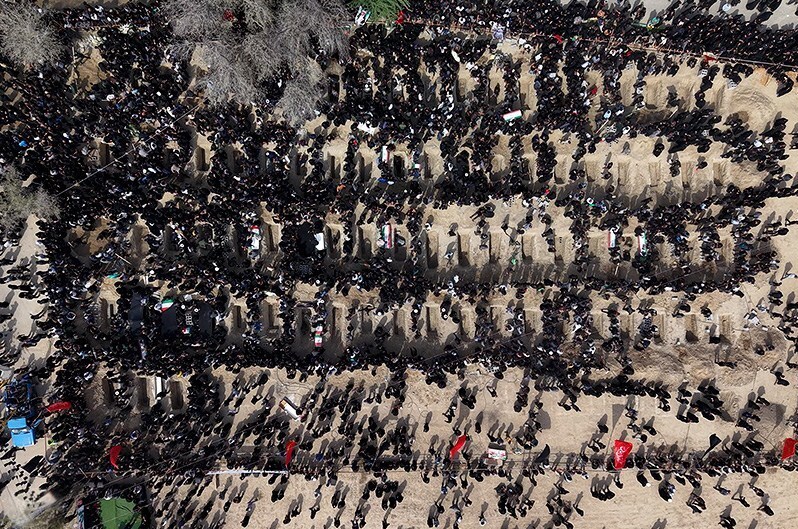
On the other side, images of funeral ceremonies, with small coffins wrapped in flags, were quickly pulled into the state propaganda machine. Instead of remaining simply a matter of asking who was responsible, the tragedy was rapidly absorbed into the government’s own narrative. This is not unusual in wartime. Before the truth is established, each side tries to fill the gap with a version that serves its interests. Minab was no exception.
But what makes the Minab case different from an ordinary fight over the news is the speed and direction of those changing narratives. At first, the idea that “the regime did it itself” or that “their own missile hit by mistake” spread very quickly in parts of Persian online space. When technical evidence, munition remains, and the early findings of the internal US investigation made that line harder to defend, the focus shifted from “who fired” to “what exactly was that building?”
Then, when it became clear that the school had shown obvious signs of being an educational center for years, a third stage began: reducing the human weight of the disaster by linking the children to a military institution, their families, or the surrounding environment. The pattern was clear. When denial stopped working, it gave way to doubt. And when doubt was no longer enough, it turned into the withdrawal of sympathy.
In the visible examples of Persian online reactions in the days after the attack, these three lines kept repeating themselves very clearly: first, blaming the attack on the regime itself; then stressing that the school was “right next to” the base or “belonged to the IRGC”; and in some cases, lowering the human value of the victims by saying that the students or their families were connected to the IRGC.
These examples are not a full count of the whole online space, and they cannot be turned into a complete statistical picture. But they are enough to show how the narrative machine worked. The problem was not only lying. The problem was that if the first line collapsed, the second one was already ready, and if the second line was still not enough, then the third line entered the scene: stripping the victim of innocence.

Where the Politics of Intervention Enters
At this point, the issue is no longer just about a few anonymous accounts or a few chaotic reactions. To understand why these kinds of patterns were able to grow at all, we need to look at the political context before the attack. In the weeks before the war, Reza Pahlavi had openly supported stronger foreign pressure.
In January, he called on the international community to “fully” stand with the protesters, target the IRGC’s command and control structure, freeze the assets of regime leaders, and expel Iranian diplomats.
Less than a month later, on the sidelines of the Munich Security Conference, he went a step further and said that US military intervention could save lives, that an attack could weaken the regime or speed up its collapse, and that he hoped such an attack would also accelerate people’s return to the streets. These were not vague remarks or second-hand quotes. They were direct and public statements.
The importance of these positions is not only in what they say on their own, but in the political framework they create. When a political project sees foreign attack not just as a terrible possibility, but as a possible tool to speed up “transition,” it runs into a difficult problem: what happens if that same foreign attack leads to the killing of children? At that point, there are only two options.
Either you rethink the whole idea of bombing as a shortcut to change, or you try to manage the disaster at the level of narrative, so you can still say the cost was heavy, but the political necessity of the project remains unchanged.
Much of the online behavior that was aligned with this camp, at least in the case of Minab, looked much more like the second path than the first. The focus shifted from responsibility for the attack to the identity of the victims, as if the more important question was not who fired, but whether the dead were “neutral” enough to deserve public mourning.
This is exactly the point where part of monarchist discourse meets the broader language of wartime propaganda. War propaganda needs one simple thing in order to survive: it needs to blur the line between civilian and military. If it cannot erase that line completely, it tries to make it unclear. If a building is obviously a school, it says, “it was next to a base.” If the victim is a child, it says, “the family was connected to the other side.”
If public sympathy starts to grow, it says, “the real story is something else.” This language does not necessarily come from one single operations room, but in practice it does the same job for war: it lightens the moral weight of killing. In the Minab case, part of the reaction aligned with the idea of intervention worked in exactly this way, not necessarily in a coordinated way, but according to the same logic.

A school is still a school, even next to a base
This is exactly where we need to clearly separate two debates that have been mixed together, sometimes on purpose and sometimes not. The first question is about the school’s relationship to the neighboring compound. On that point, the available evidence is clear: the school was part of a network linked to the IRGC, and it was located next to a military facility.
The second question is whether that physical or institutional connection made the school a legitimate target. From the point of view of humanitarian law, and even basic common sense about distinguishing between civilian and military objects, the answer is no.
The customary rules of war say that civilian objects are protected from attack unless, and only for as long as, they become military objectives. And if there is doubt about an object that is normally used for civilian purposes, including a school, it must be presumed to be civilian. These same rules also stress the duty to verify the target and take all possible precautions before an attack.
This point has also been clearly repeated in legal and expert reviews of the Minab case. Independent legal assessments published after the strike stressed that the school was a civilian object and that the students and teachers were civilians.
The fact that the school was next to IRGC facilities, or even that some children of IRGC members may have attended it, does not change that conclusion. Put simply, being the child of an IRGC member, or studying in a school run by a network linked to the IRGC, does not turn a child into a combatant.
If that principle is abandoned, then not only Minab, but any school in a garrison town or near a military center could potentially be turned into a justifiable target. That is exactly the slippery slope that the language of war tries to push society toward.
This is the context in which we should look at phrases like “it was an IRGC school” or “these were IRGC children.” On the surface, these may sound like just political statements. But in practice, they do something very specific: they take innocence away from the victims. They make mourning conditional.
They suggest that before feeling sympathy, we first need to examine the political background of the dead. Morally and legally, this logic is more dangerous than it may seem at first glance. Because it enters precisely at the moment when society must insist on the line between a child and an enemy. Once that line collapses, after the school, the hospital and the home will be next.

The State, War, and the Commodification of Death
Of course, the Minab case is not only about monarchist or American discourse. In this story, like in many other crises, the Islamic Republic was at the same time both the victim of a foreign attack and a producer of its own preferred political meaning.
The small coffins, the funeral images, the official language about “martyrs,” and the way the tragedy was folded into the state’s larger narrative all showed that the government was not going to leave the deaths of children simply as a matter of finding the truth.
In that sense, Minab became a scene where three different meaning-making machines were working at the same time: the war machine, which had to manage error or responsibility; the state machine, which had to absorb the tragedy into its own story; and the opposition machine, for which war could be seen as a political opportunity, and so its human cost had to be explained away somehow.
In the middle of all this, what gets lost are the children themselves, not as symbols, not as political capital, but as human beings who were killed at school on an ordinary morning.
That is why Minab cannot simply be called a deadly mistake and then closed as a case. Even if a final report one day says that old data, a flawed review, or a broken chain of decision-making led to the attack, that would still explain only the first layer.
The second layer, which is talked about much less, is what happened to the truth after the strike. Who tried from the very beginning to deny the tragedy? Who, once denial no longer worked, moved to make the identity of the school and the students unclear?
And who treated the deaths of children not as a moment to rethink the politics of war, but as a problem of managing public opinion? In this sense, the Minab case is not only about a targeting failure. It is also about the moral character of the forces that want to build a political future out of war.

What Minab Revealed
Minab carries a clear warning. That warning is not only aimed at armies and military commanders. It is also aimed at politicians who see war as a tool for change.
Any project that, in order to save itself, is forced to explain over the bodies of dead children that “the context also matters,” or “they were connected to that institution,” or “we should not forget how close it was to the base,” has already lost something essential: the ability to recognize the basic line between a military target and civilian life.
That line is not some luxury concern for moral idealists. It is the minimum needed for any society to remain within the boundaries of humanity.
In the end, Minab does not only raise the question of who fired. It also raises the question of who tried, after the strike, to neutralize the public shock. Who reduced the deaths of children to a matter of political bargaining. And who looked at a school and, instead of seeing a school, turned it into an exception.
Any serious response to the Minab case has to look at both layers at once: the possible targeting error or illegal attack on the ground, and the erosion of human standards in language. Wars usually survive through the second one.
Once a society accepts that some children are less children than others, the work of the missiles becomes much easier.