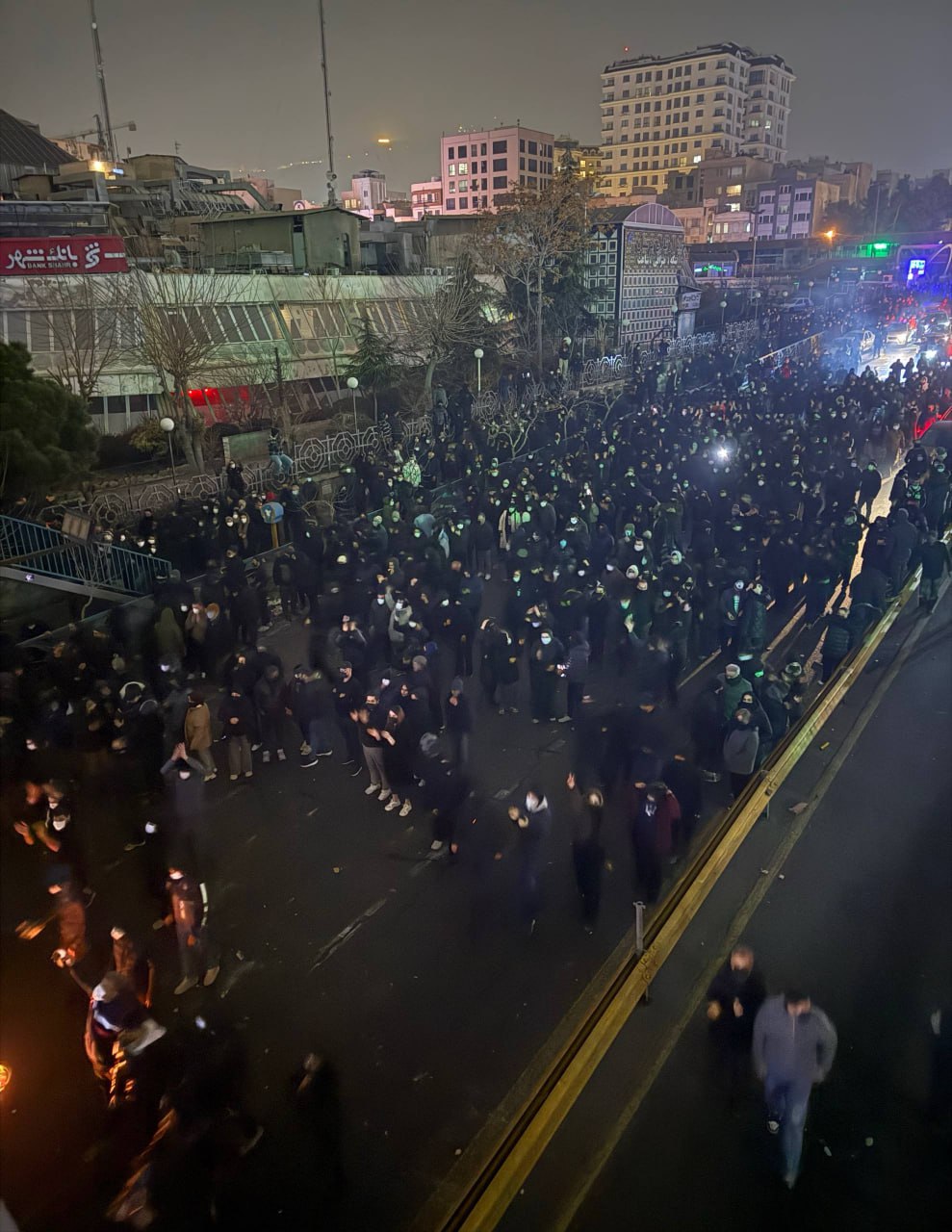
The protests are continuing with large numbers of people on the streets. For more than 60 hours now, the internet and almost all communication channels with Iran have been cut. The few videos that activists manage to publish from some cities do not really show the full scale of what is happening. There are reports describing the massacre of protesters in the streets. Regime officials claim on state media that the situation is “under control,” but the ongoing internet shutdown clearly contradicts that narrative.
At the same time, Western media are flooded with different stories about Iran. It is hardly surprising that we are once again seeing a wave of racist and deeply stupid analyses that serve the far right and erase the agency of the Iranian people. This is not the first time, and it will not be the last. The West seems incapable of looking at countries like Iran without a racist lens.
Still, let’s talk about which forces actually have a chance at power in Iran.
The Mojahedin (MEK), despite all their international networks and even direct support from some US politicians, have a structural problem: they are religious. A society that burns hijabs, knocks turbans off clerics’ heads, and has risen up against political Islam is very unlikely to accept an alternative built around religious symbols. Even if the Mojahedin have behaved with less open aggression toward their critics than the monarchists, their social chances of taking power are close to zero. The real question about them is not “taking power,” but what happens to them if other alternatives take power.
The regime’s reformists? Their only real chance lies in crushing the revolution. If they manage to calm the streets and sacrifice a few figures to strike a deal with the West, they might survive for a while. But they have no real support in society. Three years after the Woman, Life, Freedom uprising, they proved that even at the height of crisis they lack the will to change anything. A so-called “Second Republic” without a coup and without removing the very top of the power structure is more of a bitter joke than a serious political project.
Reza Pahlavi, realistically, has a better chance than the other two to take power, but not to keep it. His plan for the first 100 days is already built around repression: martial law, eliminating opponents, threatening national and minority movements, and ignoring political pluralism. In today’s diverse Iranian society, this path smells more like civil war than stability. Personal authoritarianism, the fantasy of “superior bloodlines,” and zero tolerance for criticism are the real Achilles’ heel of monarchism. A society that has risen up against lifetime rule will not accept a new version of it.
And then there is the fourth factor: The people, the progressive and left movements. The left has been brutally repressed at the organizational level, and many of its social roots have been cut. The Iranian left in exile has also failed so far to organize itself effectively. But the left still has deep social roots inside Iran, and society is very much alive: the women’s movement, the labor movement, the movement against executions, students, and political prisoners. These forces are currently standing in the doorway, blocking the return of a new form of authoritarianism. Without their pressure, all existing alternatives would drift even further to the right and become more reactionary.
Power can be taken through a coup or with foreign backing. But without society, it cannot be held. That is a reality no scenario can escape.
+ A genuinely progressive, anti-war movement today must take to the streets across the world: to defend the protests of the Iranian people and to oppose any form of foreign intervention or war.
Video showing the brutal massacre of dozens of people by Islamic fascism in Tehran. Iran Human Rights says it has so far verified the identities of 192 victims.
These videos are from the bodies of those killed on Thursday, at the Kahrizak forensic center in Tehran. Someone who has just managed to leave Iran brought them out. They bring the bodies in pickup trucks. They tell families to look through them and find their own dead.
Watch these videos and see what fascism is doing in Iran.
Iran Human Rights, a Norway-based organization, said in a warning statement that as anti-government protests spread and more than 60 hours have passed since the total internet shutdown, reports point to an unprecedented escalation in the repression and killing of protesters across the country.
The organization has now confirmed that at least 192 protesters have been killed over the past two weeks, including nine children under the age of 18.
Mahmood Amiry-Moghaddam, the head of the organization, expressed deep concern about the current situation, stressing that these figures are only the tip of the iceberg. Because of the communications blackout and severe security restrictions, independent verification is extremely difficult. He warned that estimates from some sources on the ground suggest that hundreds, and possibly more than 2,000 people, may have been killed.


Thanks for this.
‘A genuinely progressive, anti-war movement today must take to the streets across the world: to defend the protests of the Iranian people and to oppose any form of foreign intervention or war.’ I totally agree with this.