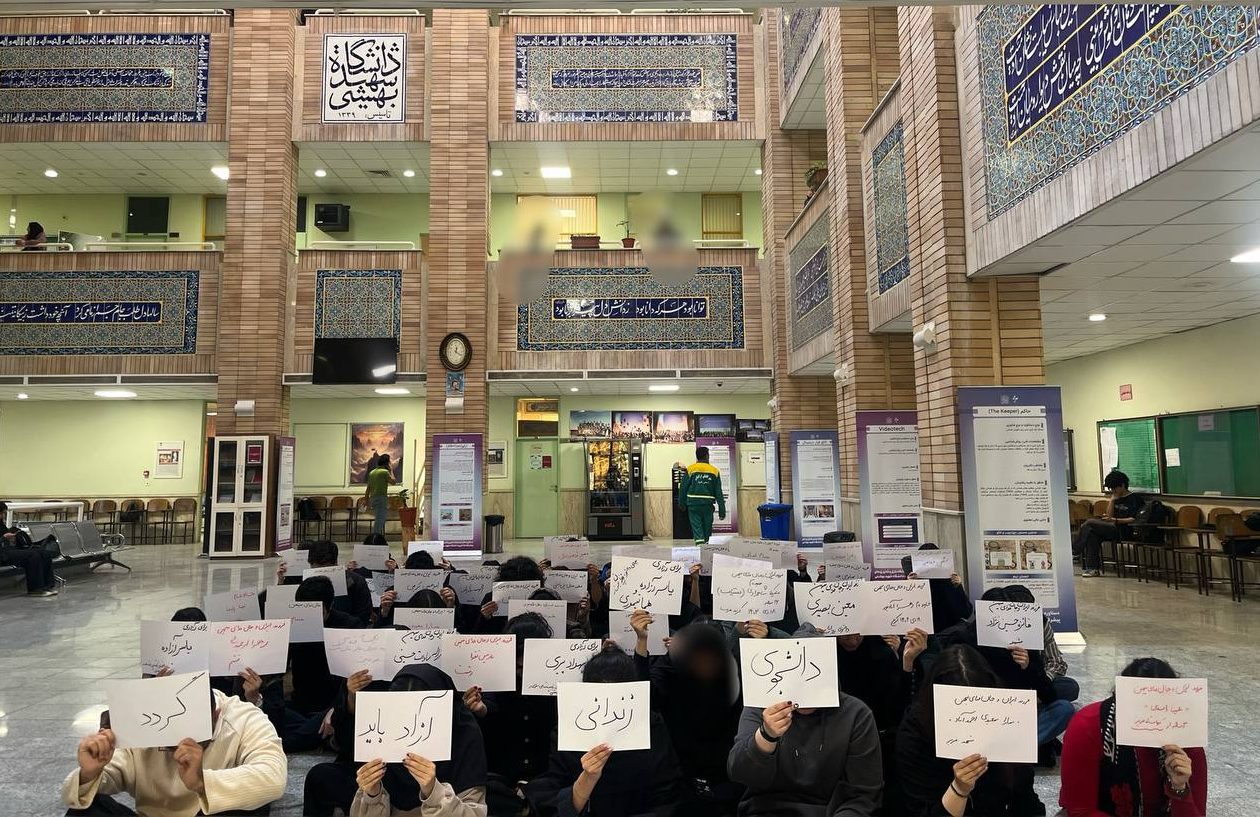
+ Photo: Students of the Faculty of Psychology and Educational Sciences at Shahid Beheshti University staged a sit-in today, in memory of those killed in January and in solidarity with detained students.
February 21, 2026, saw Iranian universities once again turn into arenas of protest, chanting, and confrontation. The first day of in-person classes after weeks of closures and online instruction coincided with the fortieth day since those killed in the January protests. Rather than marking a return to “normal life,” it exposed, once again, the deep divide between students and the state.
The January 2026 protests, which began on January 8, became one of the largest waves of unrest in recent years. Initially triggered by economic grievances — including a sharp currency collapse and the U.S. dollar surpassing 150,000 tomans — they quickly evolved into explicit political demands targeting the structure of power.
Hundreds were killed during the crackdown, among them a significant number of university students. Thousands more were arrested, suspended, or faced disciplinary proceedings. Universities were temporarily shut down and classes moved online. Yet this week’s reopening demonstrated that closing campuses did not silence dissent.
Your support helps keep this space alive but also ensures that these critical discussions remain accessible to all.
Back to Campus, Back to the Streets
From the early hours of the morning, several major universities saw gatherings form on campus grounds. At Sharif University of Technology, students assembled in the central courtyard and chanted slogans against Iran’s Supreme Leader, against “religious rule,” and against what they called “dictatorship.” Videos circulating online captured chants such as “Death to the dictator,” “Shame on this rule after years of crime,” and “Death to Khamenei.” Alongside these slogans, other groups voiced different — and at times conflicting — chants, reflecting the diversity of political tendencies among the protesters.
The gathering at Sharif quickly became tense with the arrival of Basij-affiliated student groups and campus security forces. According to footage shared online, verbal confrontations broke out between students and pro-regime groups, and the atmosphere grew heated for several minutes. Some students directly addressed Basij members, chanting, “We are the owners of this country.” The university president reportedly appeared at the scene in an attempt to calm the situation, but the protest continued for hours.
نیروهای بسیج دانشجویی به تحصن سکوت دانشجویان #دانشگاه_شریف یورش بردند و با آنها درگیر شدند.
— Farzad Seifikaran (@FSeifikaran) February 21, 2026
دانشجویان خطاب به آنها میگویند: «بیشرف بیشرف…»
شنبه، ۲ اسفند ۱۴۰۴ pic.twitter.com/HcAFoxbBVA
ویدیوی دریافتی: 'در پی شعارهای ضد حکومتی دانشجویان دانشگاه صنعتی شریف، نیروهای بسیجی و حامی حکومت به آنها حمله کردند.
— Vahid Online (@Vahid) February 21, 2026
شنبه ۲ اسفند، نخستین روز بازگشایی دانشگاهها همزمان با چهلم کشتهشدگان اعتراضات دی ماه ۱۴۰۴'#Iran https://t.co/W38Ii0oSAb pic.twitter.com/J7ol7cJBaH
Video shows a pro-regime crowd on one side and students on the other at Sharif University in Tehran, while pro-regime supporters holding flags and chant “Heydar, Heydar,” which refers to a religious Shia element of Imam Ali and Ali Khamanie. Later, they attacked the students.
At Shahid Beheshti University in Tehran, the gathering took a different tone but remained deeply political. Students from various faculties staged a sit-in and lit candles in memory of those killed in January. They collectively sang “Ey Iran,” a patriotic song that has become a symbol of protest in recent years. The names of several slain students were repeated by participants. The atmosphere was largely commemorative and mournful, yet chants against repression and arrests were also heard.
In Mashhad, students at the University of Medical Sciences gathered while chanting “Azadi, Azadi” (freedom in Farsi). Videos show students standing in circles in the university courtyard, chanting without physical clashes. However, reports indicated increased security measures around the campus and a visible presence of security personnel.
Some reports claimed that at Sharif University, as chants intensified, the call to prayer was broadcast loudly over campus speakers — an act some students described as an attempt to disrupt the gathering. Despite this, the crowd did not disperse, and the protest continued.
From Sit-Ins to Exam Boycotts
Today’s protests did not emerge in isolation. Since early February, a wave of sit-ins and joint student statements has spread across multiple universities. Students at medical universities in Tehran, Shiraz, and Mashhad staged multi-day sit-ins to protest the arrests of classmates and the killing of students in January. The slogan “A student may die, but will not accept humiliation” became one of the most repeated chants during these actions.
In some universities, students decided to boycott final exams. Statements signed by student associations declared that under circumstances in which their classmates had been killed or imprisoned, “there can be no normal return to classes and examinations.” In at least one case, students from more than twenty universities announced plans for coordinated strikes in late February.
At the same time, disciplinary cases have reportedly been opened against protesting students in several institutions. Some have described threats of suspension or expulsion. Yet these pressures have not stopped the release of new statements. One such statement read: “We picked up our pens to write, but words fall short in the face of violence.”
Universities as a Collective Memory of Protest
Why has the student movement remained active despite heavy repression and widespread arrests? The answer lies partly in the historical role of universities in Iran’s political life. For decades, campuses have been among the first spaces where social discontent becomes visible. Students, due to their age, networks, and connection to broader segments of society, often act as amplifiers of wider public demands.
The January protests, which began over economic grievances, quickly took on a political character with strong student participation. The return to in-person classes has meant returning to campuses that still carry the wounds of those events. For many students, the fortieth day memorial is not merely symbolic; it is a reminder of classmates and friends who are no longer present in lecture halls.
Meanwhile, some officials have floated proposals to designate “official spaces” for student protests on campuses — a move described as an effort to “manage” demonstrations. Among many students, however, the idea has been met with skepticism. They argue that protest only has meaning when it is spontaneous and independent, not confined to pre-approved boundaries.
درود بر دانشجویان شجاع و باشرف دانشگاه صنعتی شریف.
— علی شریفی زارچی (@SharifiZarchi) February 21, 2026
صدها نفر از دانشجویان امروز سرنگونی جمهوری اسلامی جنایتکار و خامنهای خونخوار را فریاد زدند. pic.twitter.com/kuoXMK6pId
⭕️تجمع اعتراضی دانشجویان دانشگاه شریف
— دانشجویان متحد (@anjmotahed) February 21, 2026
🔻بر اساس گزارشهای رسیده به دانشجویان متحد، امروز شنبه ۲ اسفندماه، دانشجویان دانشگاه صنعتی شریف، دست به تجمع اعتراضی زدند.
🔻از شعارهای دانشجویان در این تجمع میتوان به «آزادی آزادی آزادی»، «تا آخوند کفن نشود، این وطن وطن نشود»، «میجنگیم… pic.twitter.com/aXVqvgPfKr
⭕️تجمع اعتراضی دانشجویان پلیتکنیک
— دانشجویان متحد (@anjmotahed) February 21, 2026
🔻بر اساس گزارشهای رسیده به دانشجویان متحد، شنبه ۲ اسفندماه، دانشجویان دانشگاه صنعتی امیرکبیر(پلیتکنیک) دست به تجمع اعتراضی زدند.
🔻دانشجویان «پاینده ایران» گفتند و با شعار «این گل پرپر شده، هدیه به میهن شده» یاد جاویدنامان دی را گرامی… pic.twitter.com/2oB5q2XwoK
Students chanted: “After all these years of crime, death to this rule.” “This is the year of blood; Seyed Ali will be overthrown.” “We did not give our lives to compromise, nor to praise a murderous leader.” “Death to the dictator.” “We fight, we die, we take Iran back.” “This is the final message: the entire system is the target.”
Diverse Voices, Shared Demands
One defining feature of today’s demonstrations was the diversity of slogans and political expressions. Alongside sharp anti-government chants, other messages were voiced, reflecting the variety of political views among students. While disagreements are visible, there remains a shared point of convergence: opposition to the current situation and rejection of repression.
Social media played a crucial role in documenting events. Videos and real-time reports from different campuses allowed a broader picture to emerge. Much of this coverage was produced directly by students themselves.
Taken together, what unfolded across Iranian universities on February 21 was more than a one-day protest. It signaled that despite security pressure and disciplinary threats, universities remain one of the main arenas for expressing dissent. The reopening of campuses did not lead to normalization. Instead, it created a new opportunity for students to restate their demands.
Given the trajectory of recent weeks, the student movement appears to be entering a phase that combines remembrance of those killed with calls for accountability and broader political change. Where this wave will lead depends on multiple factors — from the state’s response to the potential expansion of solidarity beyond campuses. What is clear for now is that universities have once again become a central pulse in Iran’s social and political transformation.
Ali Akbar Abolhasani, the son-in-law of Mohammad Javad Larijani, who is a senior foreign policy advisor to Ali Khamenei, and the brother of Ali Larijani, who has been the Secretary of the Supreme National Security Council since 2025.
Abolhasani, the former Deputy for Student Affairs at Sharif University of Technology, is also a member of the university’s Basij. That means he stands right at the intersection of university, security, and power.
In a video that was released, Abolhasani tells a student: “Go to Kahrizak and look for your friends there, yeah…”
You can’t understand this sentence without the context. “Kahrizak” for people in Iran, it reminds them of detention, death, and humiliation. In this moment, it clearly points to the same morgue where shocking images of hundreds of people killed on January 8 and 9 came out in black bags, and put the whole society in shock.
This is the moment when words are not normal anymore. Every word carries the shadow of a whole system behind it. When “Kahrizak” is used as a response to a student’s protest, it means the line between a classroom and a morgue is basically gone.
The student is standing there, speaking, protesting. But the answer is not an argument. The answer is a reminder of the morgue. It’s basically a threat, pointing to a death that already happened.
This is not about “foreign interference” or some so-called “terrorism.” This is about answering protest with death. That one sentence shows the whole reality of what happened on January 8 and 9.

علی اکبر ابوالحسنی، عضو بسیج دانشگاه صنعتی شریف و داماد علی لاریجانی، خطاب به یکی از دانشجویان معترض: « برو کهریزک دنبال رفیقات بگرد! »
— Farhad Mottaghi (@farhad_mottaghi) February 21, 2026
من مطمئنم امثال اینا حتی روز حمله رو هم نمیبینن
مردم و بکشین و بیاین همون جنایت رو به عنوان تهدید استفاده کنین، یه پستی و رذالت خاصی میخواد! pic.twitter.com/ZNn5L1IA4P