While going through Telegram and Instagram, I notice that the texts I read tend to contain the same mechanism, namely, the negotiator sitting at the table, but no longer functioning as a negotiator. On the contrary, he appears as “a soldier,” “a man of the field,” “a field commander,” and his coming to the negotiating table represents “an order to fight, only in another field.” What we are facing here is a mechanism which is meant to transform politics into holy war unilaterally.
To understand what reality this mechanism works with, we need to know the context. On the ninth of February 28, 2026, Ali Khamenei, the leader of the theocracy, was killed in a joint US-Israeli strike on Tehran, and a full-scale war began. His son Mojtaba Khamenei took over from him a leadership that is now seen much more rarely in the public eye. Ports of Iran were blockaded by the navy of the USA, and negotiations were undertaken through mediators from Pakistan. Ghalibaf, who is currently leading the Iranian negotiating team and served as the speaker of parliament and the former commander of the IRGC, flew to Islamabad during the middle Farvardin 1405 to hold talks with the delegation of the USA, whose leader was the Vice President of the country. Talks lasting for twenty-one hours failed to produce any results. Several weeks later, the army chief of Pakistan, Mr. Asim Munir, flew to Tehran to persuade the Iranians into signing the contract.
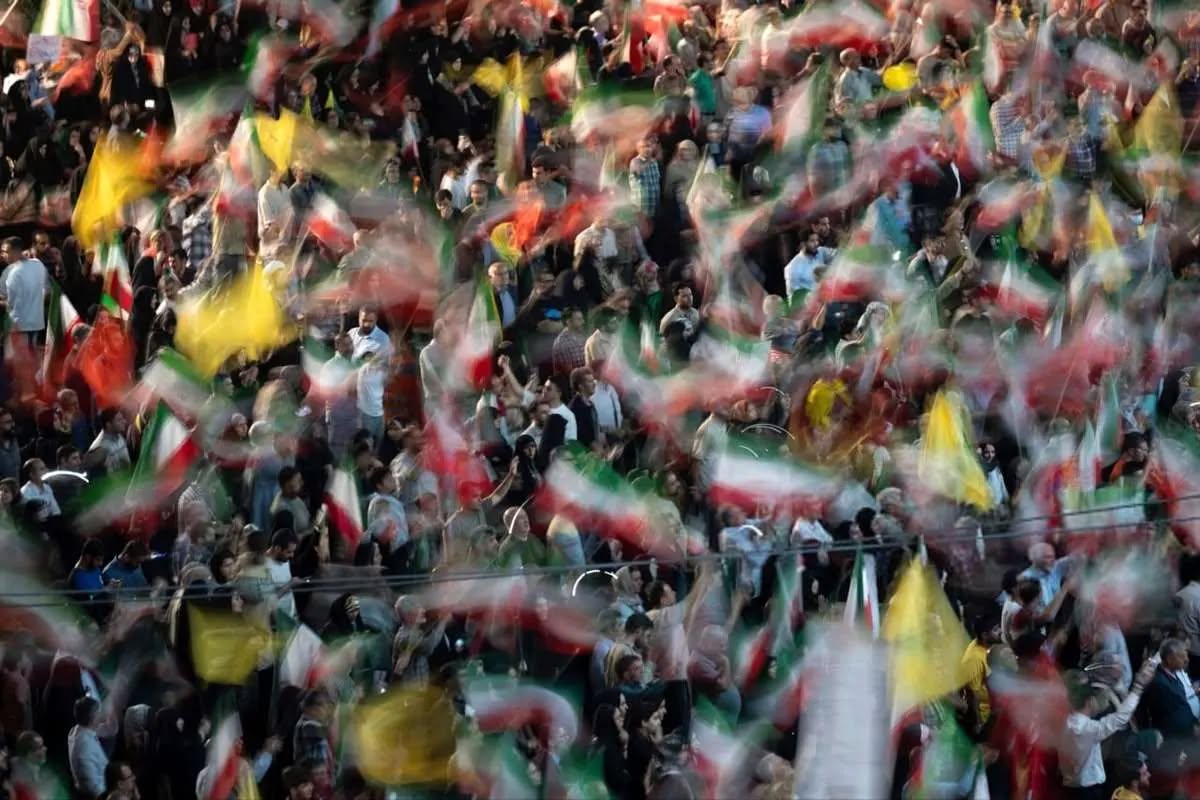
Why is this strategy important? It is an example of a communal grammar used top-down within this wave. I see Ghalibaf referring to himself in an interview on television as a “soldier of velayat-e faqih,” and claiming that he had sacrificed his “reputation” for this undesirable job. Mohammad Reza Bahonar, one of the conservative veterans of politics, asks people to go out to show their support for the negotiation team with the slogan of “blood vengeance for our leader who was martyred.” At the same time, in video clips showing nightly demonstrations of people against the negotiation team, I witness crowds of people chanting the opposite part of the grammar: “Death to the negotiator.”
Your support helps keep this space alive but also ensures that these critical discussions remain accessible to all.
Words That Need to Be Unlocked
The power of this language lies in a network of religious concepts, each of which silently carries a heavy load. The inability to unpack the meaning of these terms reduces all rhetoric into fervent prose but not into an ideological engine.
The main idea is the use of the term “soldier,” referring to “the soldier of velayat-e faqih.” Velayat-e faqih, which literally means the guardianship of the Islamic jurist, is the theoretical basis of the Islamic Republic, the idea according to which without the Twelfth Imam of the Shia Islam, an Islamic jurist should have political power. A “soldier of velayat” is a person for whom obeying the Supreme Leader is a matter of religion rather than a political decision. By addressing the negotiator as a “soldier,” we exclude him from the sphere of politics, from criticism and responsibility. A soldier does not have any right to be criticized because to criticize him would mean “to leave him alone on the battlefield.”
Secondly, there is the language of martyrdom. The concept of dying for one’s religion is, in the religious political theology of the regime, endowed with a degree of sanctity which derives from the example of Imam Hussein’s sacrifice in Karbala, the same narrative that had been employed to explain the eight-year war with Iraq of the 1980s in terms of the “Sacred Defense” (defa-e moqaddas). By labeling the present-day war as “the second and third Imposed War,” in reference to the official title of the Iraq war as the “Imposed War,” they position this new conflict in this sacred context. By labeling the dead leader as “our martyred leader,” they turn their loss into something that cannot be left unsettled; it needs to be avenged.
The third passage is eschatological. This rhetoric begins by addressing its audience as “the ordained people,” and claims that the dead leader bequeathed upon them the “glad tidings of the Return.” Ba’that (ordination) relates to the call received by the Prophet to undertake his prophetic mission, and zohur (the Return) is for the Twelver Shiites the appearance of the awaited person of the Imam Mahdi, who will fill the earth with justice. The two together elevate the lives of people subjected to shelling to the level of a heavenly spectacle of salvation.
In this context, the ritual slogan of the regime, “Death to America” becomes a parody “Death to the negotiator,” and “they do not pray behind their imam,” a reference to the practice of praying in rows behind the Imam, means that they are rebellious and heretical.
But what was the actual subject of these negotiations? According to reports, the unfreezing of roughly twenty-five billion dollars in blocked Iranian assets and the deferral of the nuclear file to a thirty-to-sixty-day negotiating window. The distance between that subject and this language is the distance between reality and ideology: haggling over money and time, in this grammar, is translated into a trial of faith on a cosmic scale.
Where the Mechanism Abandons Reality
One commonality of this machine is that it has a habit of converting all earthly events into a scene of some sort. This particular event described in the above-mentioned text is portrayed as a scene in which the negotiator makes use of his meeting with the Pakistani mediator to establish himself as someone who desires martyrdom, with the old man who had blue eyes (i.e. Ghalibaf) declaring that he had already lived for sixty-five years and could not submit to any kind of pressure for another five years. The real description of this event is different in its earthly nature. This description tells us that Ghalibaf said, “We have good will but no trust,” and also told the mediator about the US’s naval blockade breaking the cease-fire established by Pakistan.
And lastly, the people. This rhetoric speaks of “the people of the street” who have “not abandoned the streets in almost one hundred nights,” but gives them just one task: to provide the soldier “strength of heart” and “never abandon him.” A nation besieged by bombs, blockaded and impoverished is entitled to seek nothing: neither the reason for the war nor the outcome of negotiations. The audience is to be won only through conversion into loyalty.
A New Hadith for the Age of Negotiation
However, the most important skill that this mechanism is capable of doing only becomes apparent now. I observe an interview of Mohammad Hossein Khoshvaght, son of Ayatollah Khoshvaght, who is a relative (by marriage) of the Khamenei family (being brother of Seyed Mostafa Khamenei’s wife), once serving as Director-General of Foreign Press in the Ministry of Culture, talking about the future leadership of Mojtaba Khamenei. In the midst of his conversation, there is one recollection: years ago, when the “martyred leader” was very much against the negotiations with America, he asked him whether the stance of the leader was absolute or conditioned; and it became clear to him that not only the leader supported the negotiations with America, but also establishing political and commercial ties – if America respected Iran.
This particular memory is the complete opposite of what has been recorded by Khamenei. Up until just one year ago, he stated time and again in public that dealing with America would be neither intelligent nor honorable and viewed their overtures as both insulting and arrogant and not even deserving of attention. Now, in the same weeks that the regime has agreed to negotiate with America and declared a “victory” in response to the “guidance” of their leader, there is an individual memory surfacing about what the dead leader had always wished for.
The speaker is the sole witness; there is no document, no recording, no third party; and the person to whom the remark is attributed is dead and is now called “the martyred imam.” Neither of these can be either proved or disproved, but to ask about them – given that the individual who allegedly uttered them has now been canonized – is considered insolent, if not more so. It is precisely this combination of traits – being unprovable, the risk involved in asking about them, and their interpretive elasticity – which makes them ideal tools.
This is not a novel phenomenon; on the contrary, this practice has a very old tradition. According to the approach adopted for narration of hadiths in accordance with the Shia doctrine, for decades there used to be a practice of attributing certain sayings to Imams to deal with the issues of that time, which were neither proved nor refuted since there were no sources confirming the authenticity of the quotations. This became the reason for the emergence of the science of ilm al-rijal and jarh wa ta’dil, as an answer to this issue of fabrication of hadiths. Attaching the titles of “martyred leader” and “imam” to Khamenei causes a new turn of the wheel, as everything that he says becomes a hadith. This phenomenon happened before, as well, as, for example, a person working in the Office of the Leader used to claim that any lack of activity from the part of the Leader did not mean his unwillingness to take action, but merely “circumstances did not allow it.”
And that is the same machine at new business. That mechanism that understood the calling of defeat as a holy war now understands the art of turning retreat into the wisdom of death of a leader. The very negotiations that he had condemned throughout his life are, only by the premise that he cannot be challenged, what he always wanted.
This Mechanism No Longer Persuades
In this case, one can see the source of the issue. Such an approach attempts to promote the compromise reached via a system that was developed to inspire people’s willingness to become martyrs, but such a system was created not for this purpose. The concept of martyrdom, Return, and Sacred Defense served for attracting followers to the act of sacrificing oneself, but not for proving that it is acceptable to sit at the negotiating table and bargain regarding frozen assets. It demands the audience to consider the assassination of the leader, naval embargo, and incompletely reached compromise as holy war and a victory at once, yet the actual situation does not allow it. That is why we observe protests in Tehran and Mashhad and efforts to dismiss Foreign Minister Araghchi.
And the memory associated with the departed leader reveals this exact weakness. For those who operate in the framework of this logic, the memory is absolute and holy; for those who have seen the statements of recent times, however, it serves as confirmation of the exact same trickery. The tale designed to lend legitimacy to the negotiations, in other words, ends up revealing the mechanism to all who hear it. Such repetition cannot be coincidental; it is a way of thinking, not simply rhetoric. Those who think this way are not being deliberately misleading – their view is genuine. Once it moves from the internal to the external realm, however, it loses its persuasive power, because it cannot be falsified by any outcome.
I see how Ghalibaf makes his latest speech and he brings this argument full circle. He says they must “take the trench from the launcher boys and get the people out from under economic pressure.” The whole process is encapsulated within that single sentence: the economy itself is a trench, running the lives of people amounts to taking over a watch on the front line, while dealing with the crisis consists, as he said elsewhere, “of the answer to economic warfare.” In this worldview there is no peace — only a chain of trenches; diplomacy was “a different battlefield,” and now the economy is another trench.
However, in this same sentence, unintentionally, lies hidden the secret behind the construction of the whole poem. That is to say, those who are meant to be freed from pressure, society who were still under attack and embargo, remain passive agents and questions rather than anything else; they are merely an encumbrance to be transferred from one trench to another. A mechanism that wishes to turn defeat into victory could, at most, simply ask, “where is the next trench?”


