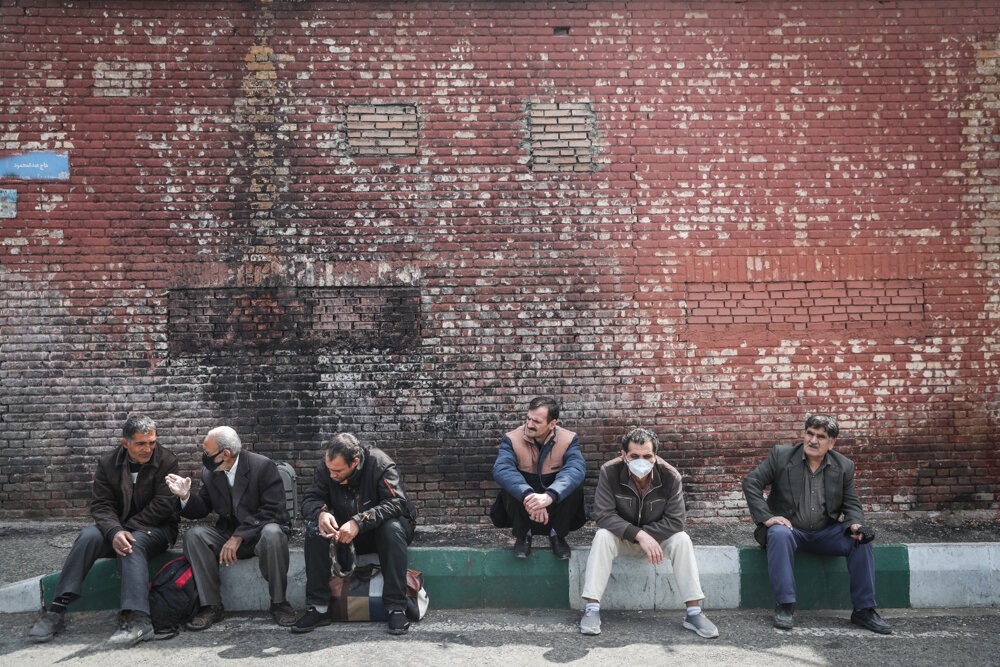
On Saturday evening, November 14, 2026, a bus carrying workers and employees from the Dehloran Gas Refinery project overturned on the road between Dasht-e Abbas and Murmuri. By Sunday morning, 12 people had died and 16 others were hospitalized with injuries. Given the severity of some of those injuries, the death toll may rise.
Twelve people who had gone to work to make a living and were supposed to return home when their shift was over. We still don’t know the mechanical condition of the bus or exactly what caused it to overturn. But we do know that safe transportation to and from work is part of working conditions. When workers travel from their homes to a project site, responsibility for their safety should not disappear somewhere between subcontracting agreements and administrative divisions of responsibility. In Iran, even establishing who is responsible for something this basic requires waiting, following up, and hoping the story won’t simply be forgotten a few days later.
I read the news, and that familiar exhaustion returns. The exhaustion of having spent years talking about the lives and deaths of Iranian workers, only to find ourselves still having to argue for their most basic rights.
Around the same time, I watch a video of Mehdi Hasan and a Palestinian-American activist discussing Iran. With that familiar colonial arrogance, they speak from the position of people living in the imperialist world, telling Iranians what they should do and, of course, reminding us that Iranians need freedom too!
Yes, they do. Iranians have learned that through their own lives and struggles, and they have paid an enormous price for it. What troubles me is that when these same people want to talk about the dictatorship governing their lives, the plunder of public resources, the exploitation of labor, or political repression, they suddenly find themselves facing a whole machinery of suspicion and accusation. The West sees everything through its own colonial lens. War!
Your support helps keep this space alive but also ensures that these critical discussions remain accessible to all.
In parts of Western media and activist circles, criticizing the Islamic Republic is quickly interpreted as siding with Israel. All you have to do is refuse to see Iran exclusively through the lens of sanctions and American military threats, and suddenly you have to prove your political innocence before you can say anything at all.
To me, this is one of colonialism’s strangest successes in recent years. In a kind of indirect alignment with the dictatorship ruling Iran, colonialism has managed to shift the West’s historical and political responsibility for Palestine onto the shoulders of the Iranian people. People who are themselves living under an authoritarian regime are now expected to answer for crimes whose conditions Western states helped create, or whose continuation they enable today through political and military support.
At the height of the Jina protests, I was speaking about Iran at an event when someone asked me what was probably the most absurd question I had heard. If the Iranian people succeed, who will support the Palestinians afterward?
This question was the beginning of the dirtiest form of character assassination I experienced in Greece. From those who, in order to avoid a right-wing party coming to power in their own country, were making all kinds of claims and excuses for not participating in the elections and not voting! Then they expected me to defend Khamenei! Simply because he stood up to America!
In this reversal of responsibility, Iranians are constantly expected to explain their relationship to Palestine. So if you want to understand why the Iranian far-right has grown in the diaspora, you need to look at this filthy colonial reality.
When we talk about the repression of women, workers, communists, and political opponents in Iran, we are easily accused of serving the Israeli narrative. And when we oppose Hamas and Hezbollah and their strategies, from within our own political movements, with our own demands and political agendas, we are treated as though we have sided with colonialism.
Isn’t it absurd that citizens of NATO countries and Western colonial powers should level these accusations against activists from oppressed countries? This is the reality of colonialism.
Someone living in Athens, Rome, London or New York, whose own state is part of the power structures that have brought Palestinians to their current situation, can simply adopt a few political positions, carry a flag or wear a keffiyeh, and suddenly appoint themselves a political judge over the people of the “Middle East.”
This alignment doesn’t necessarily come from a conscious agreement with the Islamic Republic. Orientalism and white supremacy play an important role in it. But its political consequences benefit both the dictatorship in Iran and the far right in the West.
What makes it even stranger is that these same activists, at least in the sections of political activism I have encountered, have rarely taken even their most radical forms of protest beyond largely ineffective performances. Posters, graffiti, slogans, and public displays of political positions take the place of organizing in ways that would impose real costs on the governments that actually bear responsibility for Palestine.
There are small groups in Germany that regularly make life difficult for major arms manufacturers, and they deserve support. Yet, strangely enough, these more radical and precisely targeted actions rarely find their way into media coverage.
What should I say to an old friend?

A few days ago, I was walking through Exarchia in Athens, showing the neighborhood to a friend who had brought with him a history of radical anti-fascist struggle from the heart of Sanandaj and Tehran. He looked at the walls for a while and then asked me, “Is this a neighborhood of Islamist political groups? Why are we here?”
He wasn’t referring to the slogans calling for Palestinian freedom. He was looking at the sheer number of posters and graffiti supporting Hamas and Hezbollah. At the images of Qassem Soleimani and Khamenei on the walls. For someone who has experienced the struggle against Islamic fascism in Iran, seeing these images in a neighborhood with such a radical political history was understandably confusing.
Explaining the history of Exarchia, especially on the eve of the anniversary of the Polytechnic uprising, was difficult for me. We talked about the struggle against the military dictatorship in Greece, the student movement, the anarchist and communist traditions, and the history that made this neighborhood one of the centers of radical politics in Athens. All of that is real. And so are the images on its walls.
But I was tired. Tired of having to explain to someone who had been a political prisoner in Tehran and had spent years fighting for workers’ rights why Westerners place Islamist forces, which for him represent a very real experience of repression, in the position of symbols of resistance. He didn’t need lessons from Exarchia to understand the struggle against fascism. His question came from the contradiction he could see right in front of him.
And I want to be very clear here. We Iranians have no historical or political debt to Palestine. That responsibility belongs to Europeans and the United States, which have played a role in both the history of Palestine and its present condition. Iranians are not supposed to pay the price for Western colonial policies or abandon their own rights and struggles to prove their anti-imperialist credentials. Certainly not just because the regime ruling Iran happens to chant slogans in support of Palestine!
I keep wondering how this distribution of responsibility became so thoroughly reversed. Why can a citizen of a country whose government sells weapons to Israel, facilitates their delivery, or provides political support to Israel excuse themselves from responsibility with a few slogans and claim to stand in solidarity, while an Iranian worker has to justify speaking about their own living conditions to that very same person? Why should Palestinian freedom become a standard used to restrict the freedom of expression of Iranians who are themselves suffering under dictatorship and repression?
For the past two years, I have devoted much of my energy to writing about precisely this situation. About why Iran cannot be reduced to sanctions and war. Sanctions have devastated people’s lives, and war is now tearing apart the very fabric of life. But neither provides a complete explanation for the economic and political relations inside Iran.
The Islamic Republic is more than a state in conflict with the United States. It is a power that dominates public resources, property relations, the labor market, and people’s ability to organize independently. Iranian workers are exploited within these relations and deprived of even the most basic means of collectively defending their rights.
Which media outlet is willing to write about the extreme exploitation of Iranian workers with the same urgency it brings to covering sanctions against Iran? Who wants to talk about contract workers in the oil and gas industry, subcontracting arrangements, workplace safety, and the responsibilities of employers, capital owners, and the state?
My experience over the past two years has been that these issues rarely find a place in the dominant media narrative about Iran. They simply don’t matter!
And now twelve people have died on the road between Dasht-e Abbas and Murmuri. Families are left to deal with the deaths of their loved ones, and sixteen others, according to the latest figures I have read, remain hospitalized.
At a time like this, I have very little energy left for lectures about freedom from people who are unwilling to listen to the independent voices of us Iranians.
Two years of writing about this contradiction, arguing, and explaining leave a strange kind of exhaustion in your body.
You realize that even to talk about the deaths of workers in your own country, you first have to make your way through accusations that other people have constructed for you.


I understand your frustration. I feel it about western “progressives” who have appointed themselves the saviours of the Palestinians, but by supporting Hamas and UNRWA ensure that Palestinians – who are never offered the respect of assuming they have agency, and requiring them to be accountable for their choices – are held in a permanent, toxic stasis. They function only as a way of indicating the alliances of others. Palestinianism is a blight on politics in the Middle East and the West.
I don’t, however, share your view on Israel. As Arab Islam developed its empire, many indigenous peoples, who had become ethnic and religious minorities, were persecuted and scattered. More are becoming extinct as we speak.
Jews were offered the chance to return to their land of origin at a time when 22 Arab countries were formed. Arabs dominate 99.8% of the region. Jews live in 1/5 of 1%. That isn’t in my view excessive, especially since 2/3 of Jews were murdered in Europe, & everything they owned was confiscated before they were driven out of the newly independent Arab states, in accordance with Al Husseini’s Nazi- affiliated directives.