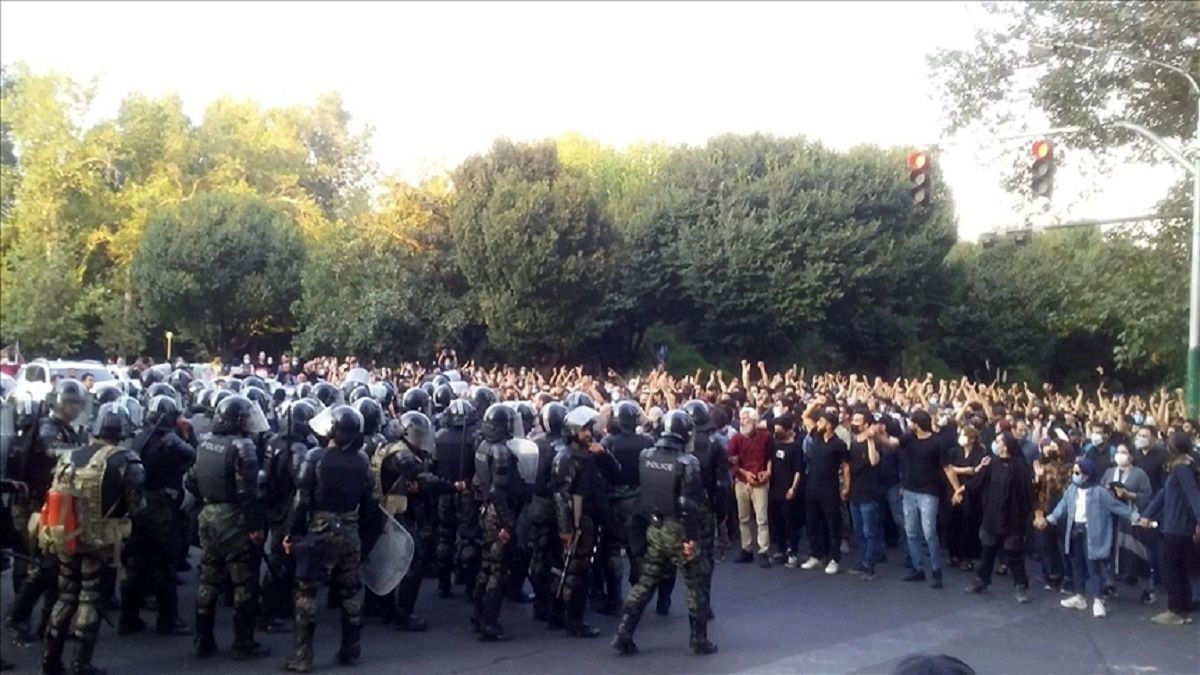
These six texts share a single concern: how political solidarity gets constructed, narrowed, and sometimes disabled by the frameworks through which societies under pressure are explained.
Each reading approaches the problem from a different angle, methodological, theoretical, and through concrete case studies, but together they build toward a specific argument: that genuine internationalism requires seeing societies in their actual complexity, not as geopolitical symbols or moral props for debates happening elsewhere.
The readings are organized in three parts. The first establishes the methodological problem. The second tests it against three cases: Iran, Palestine, and Kurdistan. The third offers a synthetic framework for thinking about what anti-imperialism must hold onto in order not to betray the people it claims to defend.
Part I / The Problem of Method
01 – Contextual Orientalism: Freedom for Some, Context for Others
Starting from the pattern of documented labor protests, strikes, and repression in Iran throughout 2025, this essay asks why significant currents of Western left discourse respond to comparable facts with incomparable urgency.
When repression occurs inside the West, or is carried out by states aligned with Western power, responses are fast and unambiguous.
When it is carried out by a state that positions itself against the United States, language softens, statements are delayed, and solidarity becomes conditional. The essay names this asymmetry as a political position (not neutrality) and argues that Iran functions as a methodological breaking point: a place where the Western left must choose between genuine internationalism and geopolitical evasion.
Questions while reading
- What specific mechanisms transform silence into a political position? Can silence genuinely be “neutral” when repression is ongoing at scale?
- The essay argues that “context” can be a tool for suspending judgment. When does providing context become a method of avoiding accountability?
- What would it mean to treat the right to organize in Iran as unconditional, the same way it is treated in Western contexts?
02 – The Racism of Anti-Racists: Bourdieu, Said, and Inverted Orientalism
Drawing on Pierre Bourdieu’s concept of “the racism of the intelligentsia” and Edward Said’s analysis of Orientalism, this essay identifies a specific failure mode: when anti-colonial vocabulary is used not to defend the oppressed, but to delegitimize those who resist their own oppressive states.
The essay, writing from my own personal experience as an Iranian exile, describes “Inverted Orientalism” as a pattern in which non-Western states are portrayed as authentic while the people who oppose them are cast as Westernized or inauthentic.
The analysis argues that Said’s work is being betrayed by its own defenders when it is deployed to silence voices from within the societies Said sought to represent.
Questions while reading
- Bourdieu describes a violence that “speaks in well-published books” and “calls you comrade.” Where do you recognize this pattern in current political discourse?
- The essay distinguishes between Said’s actual position and how his work is used today. What is that distinction, and why does it matter?
- How does the concept of Inverted Orientalism relate to the asymmetry described in Reading 01?
Part II / Three Case Studies
03 – Vijay Prashad and the Sanctions Frame on Iran
An analysis of a media interview in which a prominent left intellectual explains the Iranian crisis primarily through the lens of sanctions and external pressure, while consistently stepping back from the question of domestic repression.
The essay does not dispute that sanctions are destructive economic warfare. It asks, instead, what happens when that truth is isolated from the other truth: that the Iranian state is a rentier-security system that has criminalized independent labor organizing, jailed left researchers, and turned economic crisis into an accumulation model for security-linked elites.
The central argument is that an analysis which sees only the outer lock ends up providing cover for the inner one.
Questions while reading
- The essay introduces the “outer lock / inner lock” framework. Is it possible to oppose both simultaneously, or does opposition to one necessarily soften opposition to the other?
- The interview subject says: “I don’t want to get into domestic politics.” The essay calls this selective. What is the evidence for that claim?
- $116 billion in unreturned export currency is cited as one indicator. How does this figure complicate the standard sanctions narrative?
04 – Gaza Beyond Metaphor: On Hamid Dabashi’s Civilizational Ethics
A critical engagement with Hamid Dabashi’s After Savagery: Gaza, Genocide, and the Illusion of Western Civilization. The essay acknowledges the book’s genuine power: its refusal to treat Israeli colonial violence as a deviation from Western norms, and its reconstruction of the genealogy connecting Rome, Belgium, Britain, and Gaza.
But it argues that Dabashi’s most important insights collapse when “the West” is treated as a civilizational essence or instinct rather than as a shifting configuration of institutions, budgets, and class interests.
The result is that real agents, arms contractors, lobbying networks, border regimes, disappear behind a moral vocabulary that explains who is evil but cannot show how power is actually produced.
Questions while reading
- What is the difference between treating “the West” as a historical system of power and treating it as a civilizational essence? What does each approach make visible, and invisible?
- The essay invokes Tuck and Yang’s argument that “decolonization is not a metaphor.” What does it mean for decolonization to be material rather than discursive?
- Is the essay’s critique of Dabashi compatible with defending Gaza? Or does criticizing the frame require defending the target?
05 – Beyond the Mountain Myth: Kurdistan as Society
Kurdistan is routinely reduced to mountains, guns, flags, and a handful of armed organizations, in Western media, geopolitical analysis, and even in some solidarity networks.
In this essay I argue that this reduction is not a simple misunderstanding but a mechanism that erases the city, labor, class, everyday life, and internal contradiction, and compresses a society of millions into a symbol available for geopolitical use.
The analysis shows that this image is not only imposed from outside, certain political traditions within Kurdistan have helped produce it, when armed struggle is elevated into the sole measure of legitimacy.
The essay draws a distinction between national oppression as a real political fact and nationalism as a horizon that, once it substitutes itself for society, begins to obscure what it claims to represent.
Questions while reading
- The essay distinguishes between “armed struggle as one form of politics” and “armed struggle as a substitute for society.” What is the practical consequence of that distinction for how we understand a movement?
- The four parts of Kurdistan (Bashur, Rojava, Bakur, Rojhelat) are described as having very different histories. What are the political consequences of flattening them into a single image?
- How does the Kurdish case connect to the broader argument about Inverted Orientalism developed in Readings 01 and 02?
Part III / Toward a Framework
The most synthetic of the six texts, this essay names “campism” as the specific political formation that emerges when anti-imperialism loses its class subject. It argues that campism is not primarily an intellectual error but the product of a structural defeat: when the Western left fails to build power against its own war machine and arms industry, external states become a substitute for social power.
The essay insists on a crucial distinction, the priority of opposing imperialism is determined by the nature of the aggression, not by the virtue of the target state, and develops this through the cases of Iran, Palestine, and Syria.
It ends with a positive formulation: internationalism as a division of emancipatory labor, in which each struggle targets its own chain of domination, and resistance to imperialism is taken back from states and returned to society.
Questions while reading
- The essay argues that campism is a symptom of the Western left’s defeat, not a free intellectual choice. Do you find this structural explanation convincing? What are its limits?
- “The aim is the defeat of the imperialist project, not the political victory of the reactionary state.” Is it possible to hold this distinction in practice under conditions of active war?
- What does “rebuilding anti-imperialism from below” actually require, concretely, in Western contexts today?
Across all readings / Discussion Questions
- The substitution problem. Across all six readings, a similar move is described: the state substitutes for the people, the symbol substitutes for the society, the camp substitutes for the class. Where does this substitution come from? Is it primarily an intellectual failure, a structural consequence of weakness, or something else?
- The double standard. Readings 01 and 02 argue that political rights are applied asymmetrically, universally at home, conditionally abroad. Is this asymmetry inevitable given real differences in context, or is it a political choice that can be consciously resisted?
- The two truths problem. Reading 03 insists that two things must be held simultaneously: sanctions are economic warfare, and the Iranian state is authoritarian and anti-worker. What practical or analytical tools help hold both without letting one become a shield for the other?
- Materialism vs. moralism. Reading 04 criticizes Dabashi for turning colonial violence into a moral vocabulary rather than a material analysis. But moral language mobilizes people. Is there a tension between the two, or can they be integrated?
- Organization and representation. Readings 05 and 06 both raise the question of who speaks for a society and on what basis. When independent organizations are destroyed or absent, who can claim to represent a people’s struggle, and how should outsiders navigate competing claims?
- What solidarity actually requires. Reading 06 ends with the formula: “internationalism is a division of emancipatory labor, not the handing of emancipation to someone else.” What would this mean in practice for someone organizing in a Western country today, concretely, not in principle?


