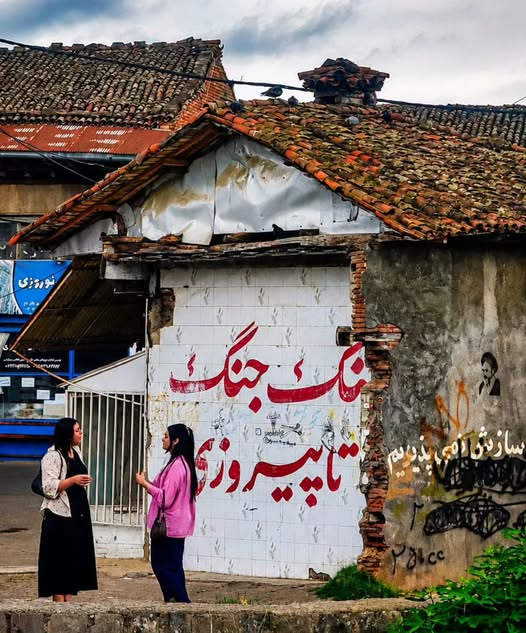
The featured image: The photo was taken by Mohammad Moheimany, an Iranian photographer who has won numerous national and international awards for his remarkable work. This image contains details that no Iranian can simply ignore. On the wall are slogans from the Iran–Iraq War: “War, war until victory” and “We will never compromise.”
Opposing bombing, sanctions and regime change imposed from abroad is the minimum political responsibility of anyone writing about Iran from inside a hostile country. But being anti-war does not have one fixed meaning, detached from where a person stands.
For someone writing in the United States, the first responsibility is clear: stand against the war machine of their own government. That is the minimum, not the end of the discussion. For a citizen of a hostile state, being anti-war means saying no to bombing, sanctions and policies that turn the suffering of Iranian people into a “strategic cost.”
But from the point of view of Iranian society, the same term takes on another meaning. Here, opposition to war cannot be separated from opposition to the Islamic Republic, militarism and the repression of workers, women, teachers and journalists.
This is the problem with some anti-war analysis, both in the West and among the Iranian diaspora. These analysts see the US-Israeli war, as they should. But they leave out the society living under a security state. Iran is reduced to a foreign-policy issue: the Strait of Hormuz, oil, the Revolutionary Guards, deterrence and the regional order. Society only enters the picture to answer one question: how much does it support the state?
Judging an entire society by whether an uprising is taking place is itself one of the cruellest ways of looking at people. Analysis becomes dangerous when the absence of protests, or the presence of crowds organised by the state, is presented as evidence of success against war and foreign intervention.
What disappears from both narratives is Iranian society itself: a society that has spent years fighting the same government that geopolitical language now presents as the representative of “Iran.”
Your support helps keep this space alive but also ensures that these critical discussions remain accessible to all.
Iran as Seen From the Chamber of Commerce
To see this society, we need to step outside the language of the situation room and listen to the language of political economy as well. At a recent meeting of the Tehran Chamber of Commerce, a businessman said that the private sector had kept the country running during war, peace and the Covid pandemic. In the video, he even mentioned that the private sector had supplied “launchers.”
Whether this was a slip of the tongue or not, it exposed his profit model. Sanctions are not a threat to him. They are a protective wall. They remove foreign competitors, close the market and direct contracts towards those with closer ties to military and security institutions.
War is not a threat either. It is an order. The state buys, and he supplies.
Where does the cost of this supply end up? Not in his accounts. It appears in unpaid wages, temporary contracts, cancelled insurance and strikes that are never allowed to begin.
This is what security-state capitalism looks like. A crisis, whether sanctions or war, becomes a profit margin for one section of capital precisely because workers have no power to resist. Profits are privatised, costs are pushed onto society and protest becomes a security offence.
The proposal to reduce employers’ share of social insurance contributions from 23 per cent to 7 per cent follows the same logic, this time dressed up as “support for production.” To increase employers’ profits, a responsibility is redefined as a burden. That burden is then removed from employers and placed on workers and the Social Security Organisation.
This decision is being made in a country where workers have no right to form independent organisations, and where strikes are both prohibited and treated as national security offences.
Workers’ representation has also been fabricated. The Workers’ House and the Islamic Labour Councils are state-created institutions designed to contain independent organising and direct protests into channels acceptable to employers and the government.
The same government that imprisons labour activists sends delegations to international organisations claiming to represent Iranian workers.
So when people say “Iran,” the question is: which Iran?
The businessman standing behind the Chamber of Commerce podium and demanding the right to run the country? The Revolutionary Guards acting like an enormous business holding company? A state that serves as the market’s police force and capital’s security guard?
Or the workers who produce everything but have no union, no job security and no bargaining power? And the society that is far more diverse than the carefully staged images of city squares now shown by state television and some foreign media?
This is the society that disappears from state-centred analysis.
From the Street to the Workplace
The protests of January 2026 developed against a background of inflation, the collapse of the rial, unemployment and the destruction of people’s livelihoods. Reading them only as “political protests” or foreign interference hides part of the reality.
The killing of protesters on 8 and 9 January, the direct shooting at crowds and the internet shutdown were not only acts of political repression. They were an extension of the same order that treats strikes as security threats and independent organising as a crime.
Early lists containing the names of hundreds of wage earners who were killed, including petrochemical and construction workers, teachers, nurses, drivers, street vendors, working children and pensioners, show how artificial the boundary between a “political issue” and a “labour issue” really is.
The same connection can be seen in workplace safety. The explosion at the Tabas mine, which killed dozens of workers, was not simply an accident. When workers have no power to stop unsafe work, their deaths are connected to the same structure that keeps them unorganised and without a voice.
Journalists and nurses are part of the same struggle. A journalist is not only a defender of freedom of expression. A journalist is also a worker with the right to an independent professional organisation.
A nurse is not only a “healthcare hero.” A nurse is a worker with the right to strike and defend their wages.
When reporting becomes a national security crime, and nurses’ strikes are answered with suspension and arrest, the issue comes back to the basic right of workers to organise.
What Does This Have to Do With Being Anti-War?
A state that denies society the right to organise, strike and choose its own representatives is the same state that claims to represent the whole of society during wartime.
The section of capital that profits from privatisation and cuts to social insurance during peacetime presents itself during war as the force keeping the country alive. The security apparatus that represses protests over wages and living conditions finds an even more legitimate-sounding language for the same repression under wartime conditions.
Any criticism of war that begins with society must also recognise this system.
Opposition to US and Israeli bombing must not lead to silence about the Islamic Republic’s security economy. At the same time, criticism of the Islamic Republic must not slide into normalising war and siege.
Iranian society is trapped between two forms of violence: the violence of war and external pressure, and the violence of the state at home. Being anti-war from the position of society means pulling people out from between these two forms of violence, not allowing one to disappear into the other.
This is why the position taken by some Iranian-born analysts in Europe and the United States is more than a simple analytical disagreement. Those who understand Iran only through the state, “resistance” and deterrence erase the very society that is supposed to be saved from war.
What makes this even stranger is that some of these people support unions, social justice and figures such as Mamdani when discussing domestic US politics. But when it comes to Iran, the repression of organised workers and protesting teachers suddenly becomes secondary.
Socialism is apparently good enough for New York. But in Iran, “survival” and “deterrence” suddenly replace society.
Iran cannot be seen only from the situation room.
It must also be seen through unpaid wages, worthless insurance, workers without unions, teachers facing security cases and families who are frightened both of war and of a state that has turned their everyday lives into security matters.
This situation was not created by sanctions or foreign interference. It is part of the way Iran is governed.
Neither US and Israeli bombers represent freedom, nor does the security state represent Iranian society.
Unless this distinction is protected, being anti-war turns into the language of state survival, while criticism of the Islamic Republic becomes a tool in the hands of forces that care about Iranian suffering only when it serves their own political agenda.
The point is not to criticise war less. The point is to return to the centre the society that is being erased under the names of war, security, resistance, the market and the state.
As long as this society remains invisible, every analysis of “Iran” will be missing something. And what is missing is not a minor detail. It is politics itself.


