| This article was first published in Evrensel.
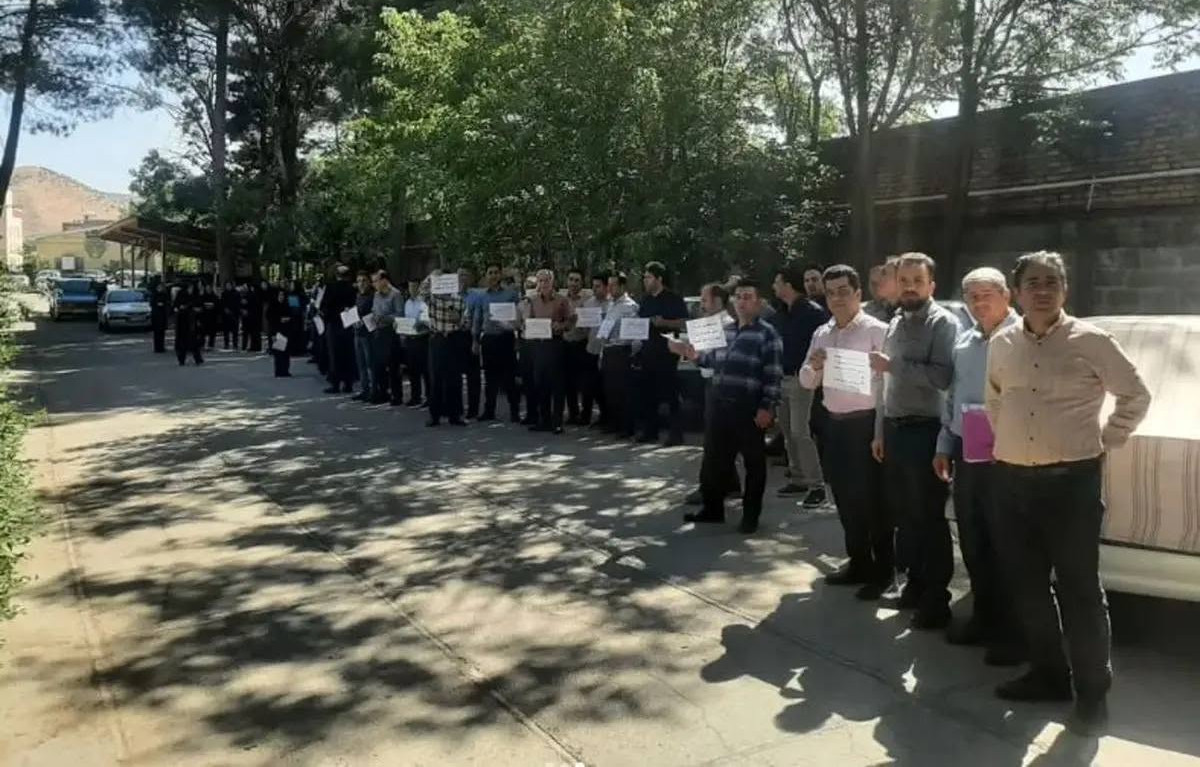
| Photo: Protest rally of employees of the West Eslamabad/Kermanshah Health Center
On Sunday, June 14, 2026, pensioners from Shush, Karkheh and Haft-Tappeh, towns in Iran’s southwestern Khuzestan province, again gathered outside the local Social Security office, demanding enforcement of Articles 54 and 96 of the Social Security Law and an end to the deductions taken for what the state calls “supplementary insurance.” According to the labor news agency ILNA, the protest looked much as it had in previous weeks. It was not a new event but the continuation of one that has not stopped: a week earlier, pensioners had stood in heat above 45 degrees Celsius, and the week before that the same demand went up at the same hour in Shush, Tabriz and Rasht.
These lines outside labor offices are the surface of a deeper rupture, one the spring’s war accelerated by hollowing out the floor of the country’s production.
In early April 2026, the joint American and Israeli campaign moved beyond nuclear and military sites to strike the spine of the civilian economy. The pattern was deliberate: not only factories but their utility units, the plants that supply the power and steam without which a whole complex cannot run. According to Iranian economic outlets, petrochemical complexes in Mahshahr, Asaluyeh and elsewhere were hit, but the decisive blow fell on two utility hubs, Fajr Energy and Mobin Energy, in the Pars Special Economic Zone. The zone holds more than 60 percent of the country’s petrochemical capacity, and once both went offline, output reportedly fell by more than 80 percent. Refineries at South Pars and on Lavan Island were struck, and in steel the country’s two pillars, Mobarakeh and Khuzestan, were damaged. Various estimates put the cost near 270 billion dollars, a figure best treated as approximate.
A blow to a utility hub does not stop at one plant. When power and steam are cut, the downstream workshops that depend on a complex’s product fall idle too. The aim was not to destroy a single line but to break the chain.
Your support helps keep this space alive but also ensures that these critical discussions remain accessible to all.
A tsunami of unemployment
The direct result is what activists call a tsunami of unemployment. By various reports, somewhere between one and two million workers lost their jobs, and around 200,000 filed for unemployment insurance in the weeks after the war. The order of the fall was not random. The first out were the contract and subcontracted workers of the petrochemical sector, those with no direct contract, whose security was already worn thin. This is the order built into Iranian industry long before the war, through privatization and the handing of labor to contractors. The war did not create it; it made it visible at speed.
The destruction spread downstream, to auto parts dependent on steel and plastics, to construction short of steel, to packaging. Roughly 55,000 industrial units, by the source accounts, now sit near closure. And the dismissals were not the war’s work alone: the wave had already begun after the Nowruz holiday in late March, before the strikes peaked.
A reserve army of the unemployed outside the gates breaks the bargaining power of those still inside. With a line of job-seekers at the door, employers have pressed the still-employed to give up legal raises rather than be fired. And the wage, when paid, does not cover a life. In March 2026 the Supreme Labor Council raised the minimum wage by 60 percent, to around 20 million tomans with all allowances, while in the same session it put a worker family’s basic monthly basket at roughly 43 million. The body that sets the wage admitted, with its own number, that pay covers less than half of what living costs. Inflation then swallowed the gap: prices for staples such as oil, meat and eggs reportedly doubled or more, and dairy consumption fell sharply, the point at which a worker can no longer afford basic protein. The collapse has even pushed labor abroad; in late May, reports said 38 Iranian workers were beaten on tea farms in Turkey after demanding their pay.
A struggle taking shape again
In the middle of this, the pensioners are back, but the return continues something that never ended. Ali Nejati, a labor activist from Haft-Tappeh, notes that pensioners’ protests have run without a break since the autumn of 2020. The demands are legal and plain. Under Article 54, they say, the Social Security organization must provide all medical care free, yet after 30 to 35 years of premiums it does not; in their words, an imposed insurance, the looting of pensioners’ pockets, money taken and no service given. Article 96 ties pensions to real inflation but has stayed on paper, and some pensioners receive, by some accounts, the equivalent of 90 to 115 dollars a month. This is pressed from the street, in the 50-degree heat of Shush, by people who after a lifetime of work should be at rest. Their protest is one voice in a wider field, alongside a labor and trade wave running through these same weeks and the nationwide protests that spread across the country from December 2025.
The hardships ahead
The road ahead is hard, and the obstacles are structural. The act of organizing has itself been criminalized: independent unions, the right to strike, collective action, all suppressed under the heading of “security,” with activists facing prison, dismissal and surveillance. The bodies meant to represent workers do not. The Islamic Labor Councils and the Workers’ House are state-created institutions built to limit independent organizing and to channel grievances into forms the employer and state can accept, an obstacle to a real union, not a substitute for one. And the same reserve army the war produced blunts the strike itself, since the threat of stopping production loses its force when hundreds of thousands are ready to take a striker’s place.
The root, as the source material insists, does not lead back to the war alone. A country rich in oil, gas and farmland had, years before the first missile, stripped out permanent employment and left the worker exposed. The war did not blow up this structure; it displayed a fragility already built in.
What is seen in the lines at Shush and Karkheh is not the image of a victim, but of people who, in 50-degree heat, are still on their feet and still demanding. Nejati locates the way out in unity and in the building of independent organizations in workplaces and neighborhoods. In his words, there is no savior but the laboring masses themselves.


