The daily newspaper Sazandegi occupies a specific and revealing position within the political architecture of the Islamic Republic. It is directly affiliated with the Executives of Construction Party of Iran, a party that emerged in the post-war period and consolidated its influence during the presidency of Akbar Hashemi Rafsanjani in the 1990s.
Since then, Sazandegi has functioned as the unofficial mouthpiece of a technocratic network rooted in the upper layers of the state: senior administrators, policy planners, market-oriented economists, and politicians whose vision of “development” is anchored in stability, capital accumulation, privatization, and détente with the global order.
Your support helps keep this space alive but also ensures that these critical discussions remain accessible to all.
For readers unfamiliar with Iran’s internal factional landscape, this current is often described as “reformist.” But this label is misleading if understood in democratic or emancipatory terms. The reformism represented by Sazandegi is managerial rather than popular, technocratic rather than social. Its central concern is not political participation, redistribution, or mass agency, but the efficient administration of crisis within the existing system.
Sazandegi is not a mass newspaper or a paper of record. Its influence lies in its proximity to power: it functions as an elite, technocratic platform through which parts of the Iranian state debate, test, and reframe responses to crisis.
Economically, the paper consistently defends a localized form of Islamic neoliberalism: market discipline, austerity, and privatization embedded in a security-oriented state that actively suppresses independent labor organizing and left politics. Politically, it is deeply leftophobic. The left appears in its discourse not as a legitimate social force, but as a destabilizing threat—associated with radicalism, disorder, and uncontrollable mass mobilization.
This leftophobia is not merely rhetorical; it is structural. Sazandegi speaks for that segment of the ruling establishment that is deeply distrustful of street movements and popular politics. From this perspective, protests are not expressions of collective grievance or social struggle, but disruptions to be contained, redirected, or technocratically managed. The ideal horizon is one in which the system survives intact, markets continue to function, crises are handled by experts, and politics retreats into closed rooms insulated from mass pressure. Repression, poverty, and protest are acknowledged, but they are framed as “governance problems” rather than symptoms of a profound crisis of legitimacy.
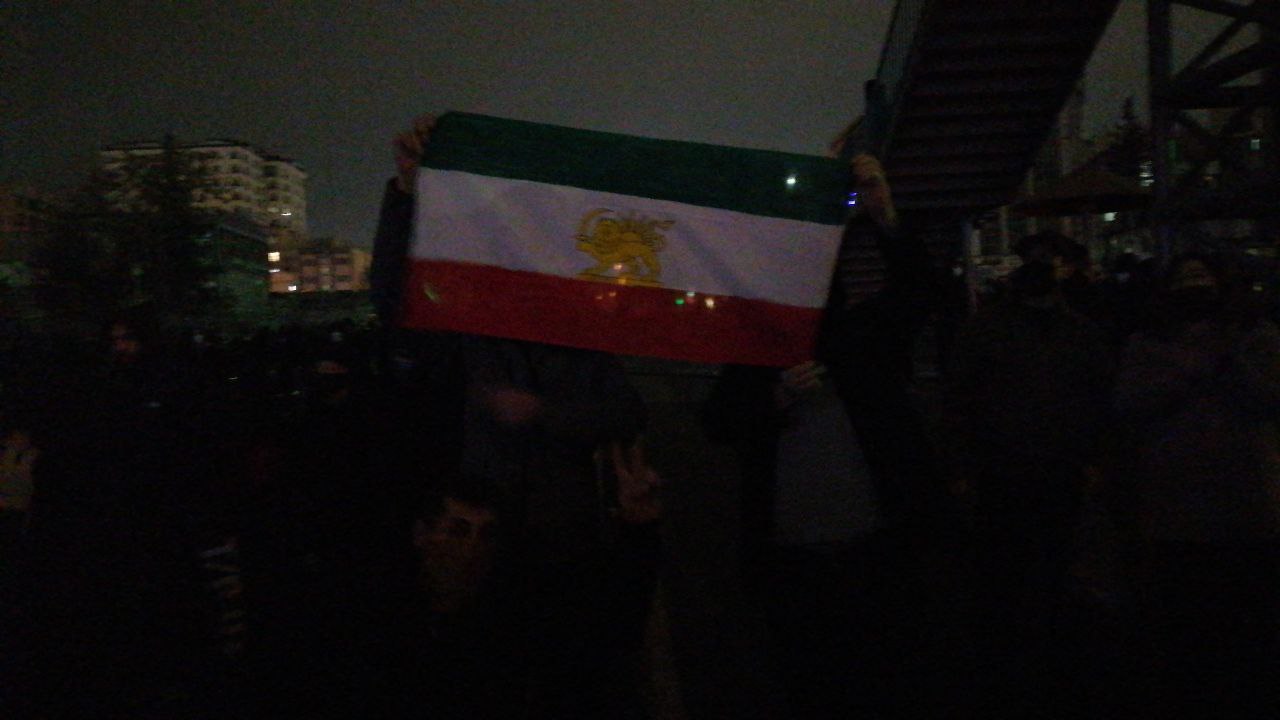
It is against this backdrop that Sazandegi’s recent decision to place the Lion and Sun symbol on its front page must be understood. In contemporary Iran, symbols no longer operate as neutral references to history. After repeated waves of uprisings and the brutal killing of protesters, the country has entered a moment in which memory and identity themselves have become contested political terrain. Symbols circulate not as cultural ornaments, but as condensed expressions of refusal, grief, and antagonism.


The sensitivity of this terrain was underscored a day earlier by remarks made by Gholamreza Salehi Amiri, head of the Iranology Foundation. Salehi Amiri stated that the Lion and Sun “has roots in Iranian-Islamic identity” and “belongs to the Islamic Republic.” This was not an offhand cultural comment. It was a political claim about ownership: who has the authority to define national symbols, and under what conditions.
For a non-Iranian audience, it is important to understand the institutional role behind this statement. The Iranology Foundation is not an independent academic body. It is a state-affiliated institution tasked with producing and policing an “official” narrative of Iranian identity compatible with the ideological needs of the regime. When its head intervenes in a symbolic dispute, he does so not as a neutral historian but as a political actor. Salehi Amiri’s claim was therefore not an exercise in historical interpretation, but an attempt to fold a contested symbol back into the regime’s authorized identity framework.
Historically, the Lion and Sun was a symbol of the Iranian state—not of a specific ideology, religion, or monarchy. It appeared in multiple forms across centuries, including during Islamic periods, long before the emergence of the modern nation-state. Crucially, it was not inherently monarchist. The Islamic Republic removed the symbol after 1979 precisely because it conflicted with the regime’s identity project, which sought to ground legitimacy in a fusion of Shiʿi Islamism ideology. Over time, and largely by default, the symbol became associated in exile politics with monarchism, even though other actors—such as the MEK—also used it as a national emblem.
What has changed in recent years is not the historical meaning of the symbol, but its social function. In the context of mass protest and state violence, segments of Iranian society have reclaimed older national symbols as tools of negation—ways of expressing rejection of the Islamic Republic without necessarily endorsing any specific alternative regime. This point is often misunderstood outside Iran. The reappearance of such symbols does not automatically signal monarchist politics; it reflects the closure of political space and the search for shared signs through which dissent can be articulated.
This is precisely why the intervention by Sazandegi and the Iranology Foundation matters. By printing the Lion and Sun, Sazandegi did not suddenly become monarchist, nor did it embrace romantic nationalism. Instead, it performed a familiar technocratic maneuver: extracting a symbol from the street, relocating it into an institutional setting, and re-encoding it within the boundaries of the existing order. Salehi Amiri’s statement functioned as the ideological seal on this process, asserting that the symbol could be safely absorbed into a “reinterpreted Islamic Republic” without threatening its foundations.
This is not reconciliation. It is symbolic capture.
What matters here is not which political tendency once used this symbol or claimed it historically. The point is that this flag has been transformed into a symbol of revolt by a significant part of Iranian society against the Islamic regime and should be understood as such. To strip it of that context and reintegrate it into an official narrative of national continuity is to neutralize its political charge.
Sazandegi’s move exemplifies a broader strategy pursued by technocratic reformism in moments of deep crisis: absorb what cannot be fully repressed, sanitize what cannot be erased, and translate social antagonism into a language of managed reform. Symbols are tolerated—even celebrated—so long as they are detached from mass politics and stripped of their oppositional content.
For outside observers, this episode offers a clear window into the deeper conflict shaping contemporary Iran. The struggle is not only over institutions or policies, but over who gets to define the meaning of Iran itself: a society in revolt, or a system in need of better management.