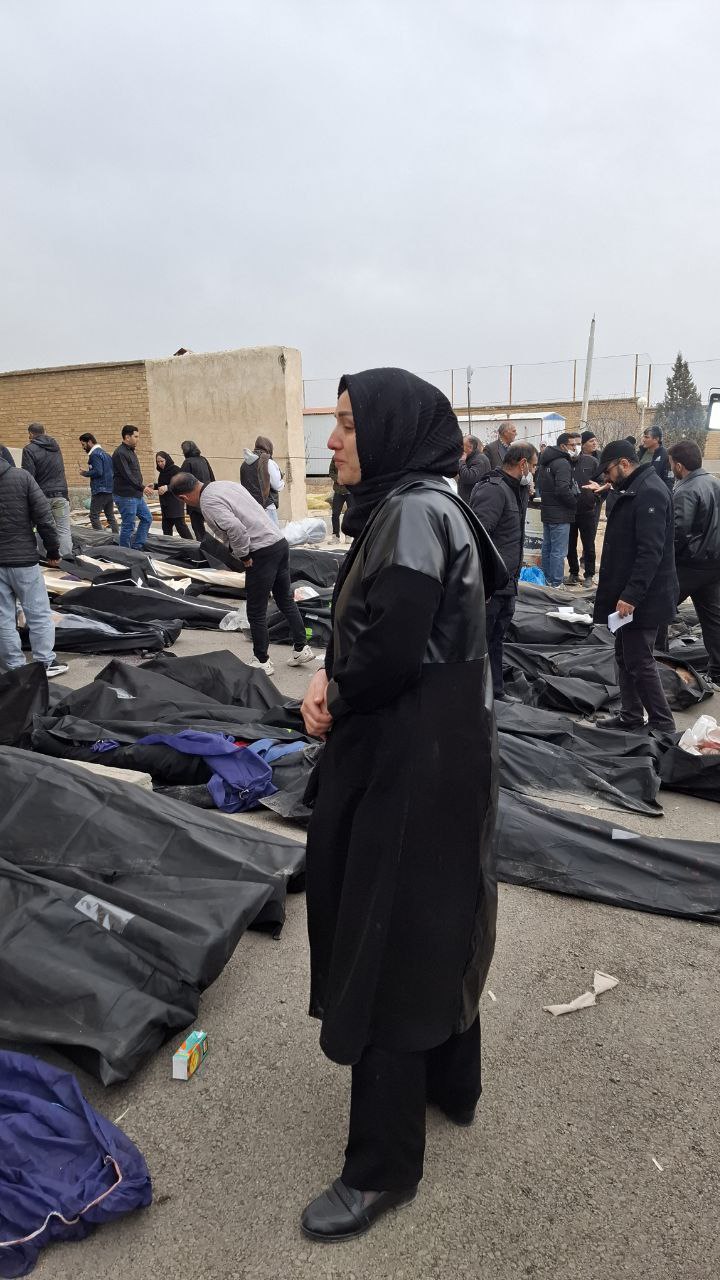
The news is horrifying for all of us. Not only because of the people who have been killed, but because of the shape of death itself. Seeing the bodies of hundreds of people in black bags. Seeing death being “processed” like an administrative file. Like a queue. Like an invoice.
In the middle of an internet blackout, Islamic regime state TV anchors speak with confidence about “terrorists killing people.” It’s an inversion of reality: turning the victim into the aggressor, flipping the roles of killer and killed, swapping the street with the prison.
In those same hours, the few people who could get through the Internet were saying this: they’ve set up a monitor at the cemetery so families can look at images of the bodies. When they see a number on the screen, they go forward to collect the body. As if human beings have been reduced to a “code.” A “turn.” A “case file.” And then they charge families money to receive their loved ones: the price of the bullet, the price of “services.”
This isn’t just violence anymore; it’s the mass production of humiliation. It’s the moment fascism doesn’t only kill, it wants you to understand that even in mourning, it owns you.
Then comes the street performance of “regime supporters” under the label “Lovers of Iran.” A state-run theatre: a directed crowd, carefully framed, meant to wipe the blood off the lens. They act as if the issue is simply “two narratives”—as if we’re dealing with a disagreement, not with a machinery that turns death itself into forms, fees, and lines. It feels like watching a scene from a sci-fi movie, not real news from a real society.
And that surreal feeling is exactly what hit millions of Iranians, regardless of their politics or culture, when they were cut off from their relatives and friends: nameless anxiety, faceless fear, and helpless rage.
It’s more than a week, and we still don’t have a clear picture of what is happening inside Iran. We don’t know exactly what occurred. Many dimensions of this crime remain unknown because the blackout, censorship, and intimidation have pushed people’s testimonies off the stage.
What we have is a one-sided, managed narrative, the narrative of the same institution that acts at once as judge, newsreader, and executioner. Here they don’t only kill bodies; they kill truth too.
And now, we Iranians diaspora must confront something else, Orientalism: when Iran is viewed only through a geopolitical keyhole, when people are separated from their lives and turned into symbols. As if thousands went to the streets for no reason rooted in lived experience. As if unemployment, poverty, humiliation, dispossession, the crushing of independent organising, street killings, and decades of suffocation are “details,” while the “real story” must be found in the think tanks of global powers.
This level of racism and simplification gets thrown at us in the name of analysis.
One version of Orientalism tries to prove that “Islam is like this or that,” as if Iranian society were a theology lab rather than a battlefield shaped by class, politics, gender, and generation. Another version, with a tone that pretends to be “realistic,” insists on wrapping everything up with a ready-made line: “Of course, the US is pursuing regime change in Iran.” As if that one sentence can explain the bodies, neutralise the bullets, lift responsibility from the killer, and hand it over to the sky of foreign policy. As if people must first pass a test of “correct geopolitical positioning” before they earn the right to live.
But we Iranians, at the very moment these bloodless, bodiless analyses are being arranged on tables, are looking at the black bags. At the line of families. At the cemetery monitor. At the receipt for the “price of the bullet.” At the naked truth that in Iran, death is not only a tragedy; it is a system. A bureaucracy.
And Orientalism, whether it comes as Islam-obsessed “expertise” or as geopolitics-addicted “realism”, becomes most dangerous precisely when it makes this system invisible: when it scrubs blood out of the story and strips people of their humanity.
Iran, Tehran. Saturday, January 10.
Sound of gunfire and bloody scenes
Carrying the wounded along blood-soaked sidewalks, under the sound of people being shot at.
One person says, “I don’t have a belt.” Another (dragging his leg, drenched in blood) takes off his belt: “Here, here, here…”
In the final seconds, someone is still looking for a belt. (00:20)
The video was first posted on Twitter and later shared by Media Activist (Vahid Online).