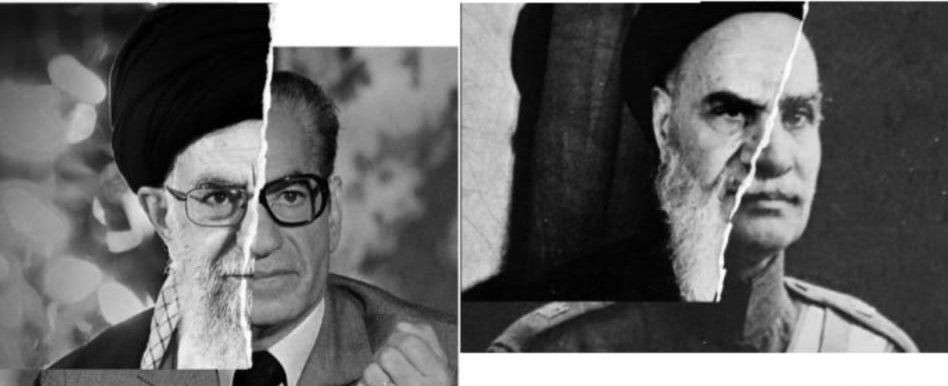
Atatürk, Mohammed bin Salman, Hitler, and Reza Shah. In the time of the coronavirus, those who worked as service providers in Tehran were asked what could be done for the betterment of their conditions. And the thing most often mentioned was that there needed to be someone who would come and do things right.
I was hearing Ali Moazami, a translator and researcher of political philosophy, give a speech at a book talk event held at the Damavand Bookshop in Tehran. What was being asked of him was rather straightforward. Does the middle class have a part to play in the emergence of authoritarian regimes? His response takes us from the recent history of Iran to places that the conventional narrative rarely goes: the peripheries of Tehran.
Moazami starts off with “transitions” in the literature on politics. The major debate in this field from the 1980s has been about the processes through which an authoritarian regime evolves into a democratic state; however, as examples have begun to multiply, the process of moving from a parliamentary state to an authoritarian regime has gained equal importance. Examples include Bangladesh prior to its recent revolt. From this pendulum swing emerged a new notion.
Your support helps keep this space alive but also ensures that these critical discussions remain accessible to all.
Such a regime continues to be authoritarian in nature; yet, it maintains democratic institutions and utilizes them. It has elections; yet, it is able to control them in such a way as to make sure that the desired outcome is achieved from the start. It grants freedom to professional organizations; often it grants more freedom than it would be expected; yet, it clearly outlines their role in such a way as to force them to accept its rules.
He then discusses an event in which Iranians themselves have experienced, which is the emergence of the first Pahlavi government, a form of limited democracy that eventually fell into the hands of one person. Reza Shah did not change anything in the constitution of the Constitutional Revolution. The constitution was changed for the first time in 1949, following the assassination attempt on Mohammad Reza Shah. Therefore, the first Pahlavi governed on the basis of the very same constitution, and using this constitution, he created one of the most despotic eras in Iran’s history immediately after the era of democracy which was affected by crises, especially the First World War.
But which force carried Reza Khan to power? Moazami ties his rise to the creation of a centralised national army, one army covering the whole country. The constitutional government had wanted such an army for years. Britain and Russia blocked it, and the treasury could not pay for it; its efforts never went much beyond bodies like the gendarmerie. After the February 1921 coup, the old dream finally took shape, but not as the constitutionalists had imagined it.
Even before Reza Khan ascended to power as the Shah, when he was working as the Minister of War and Prime Minister, the army controlled the key veins of the country. They captured the customs and hence the major sources of income of the state. They quashed the rebel tribes and centers of powers in the country and thereby Reza Khan gained tremendous popularity among all strata of society, especially from the peripheral areas of Iran.
Here Moazami challenges the usual story, the one that says constitutional intellectuals and the middle and upper classes, worn down by failure, decided the country needed a strong man. The idea is there in the words of leading constitutional figures, and some of them even backed Reza Khan before he pushed them out of politics. But Moazami’s point lies elsewhere.
The institutions through which power was actually taken, the army and the police, had no organic bond with anything we could call intellectual life or the middle class. Their rank and file did not come from the middle class, and in the early years neither did their commanders. Reza Shah’s state is unthinkable without these two institutions, and at different stages they shaped political decisions themselves.
The same pillar continued to hold ground even when Mohammad Reza Shah was ruling. During all the crises, whether it was the prime minister coming from the army or the military entering into the cabinet, the people surrounding the Shah would say the same thing: as long as the army remained loyal, there would be hope for him. A number of theories suggest that the reason why he collapsed was because of the weakening of the army. It is from here that the first proposition by Moazami arises. In order for a government to continue being an authoritarian one, it should be able to apply force wherever necessary. For that, it has to rely on those who are behind the application of the force.
His second question returns to the present. Is the recent turn towards the Pahlavi monarchy an authoritarian tendency, and can it be called a middle-class one? To answer, Moazami points to one historical moment and one research project. Monarchist groups first entered the media’s serious political discussion in 2009.


In any case, there were at least some suspected members of Anjoman-e Padeshahi-e Iran, also known as the Kingdom Assembly of Iran, who were incarcerated, and two others were put to death following their trial, which Amnesty International found to be fundamentally flawed. According to Moazami, all those arrested and given harsh sentences hailed from the impoverished districts of Tehran, none of whom could be considered to belong to any middle class and had defined themselves politically as such.
The middle-class voices of this trend arrived much later. The influencers, media personalities, and public speakers came mainly within the past year. Moazami declines to name them, but he notes that some had been speaking publicly for two or three years, and their language already carried anti-immigrant themes: serious right-wing elements that were in place before they merged with this political current.
Then comes the research. Moazami refers to a panel called “The Lower Classes and Social Change,” held in Esfand 1401, the month running from late February to late March 2023. Two presentations from that event feed his argument. Bashir Khademlou presented a study called “On the Edge of the Metropolis,” on the multiple mechanisms that push people down and the plural political possibilities that follow.
By his own account the research was still incomplete, but it drew a clear picture of Tehran’s satellite towns. In some of them, seventy per cent of residents do not work where they live; they ride into Tehran each morning and return only to sleep. Another figure completes the picture: more than eighty per cent of these residents had moved there from Tehran. They are the poor and the lower layers of the middle class, priced out of the city as life grew harder, while their jobs stayed inside it.
The service workers of Tehran during the pandemic were mostly from this world, and Mirsaeed Nikzad conducted a set of interviews with them in his study, “Alienated Labour and the Emergence of the Antagonist.” Their jobs were such that they could not afford to be at home, and they faced some of the worst cases of infection and mortality rates. Based on these interviews, Nikzad outlined several major lines regarding their politics, which Moazami takes us through in order.
First, a gaze fixed on the past, the product of living conditions that keep falling. These workers look back with constant regret, but the past they mourn was never bright or comfortable. Their present has simply dropped below it. Here I paused the recording, because Moazami pauses too. He reminds the audience that pro-Pahlavi propaganda also faces the past, with one major difference. The past these workers remember was never perfect. The past shown on monarchist media is: everything was good, and then everything was lost.
Second, alienation from the wider world and a retreat into the self. Most interviewees blamed themselves for their misery. We are useless. I could not work properly. It is as though no world exists around them, no system holding them in place or pushing them down. And the contradiction sits right beside this. When the same people describe the world outside, they describe overwhelming, unchangeable forces that decide their fate. The language runs in two directions at once: guilt turned inwards, and an outside world treated as beyond reach and beyond change.
Next, the appeal to authoritative leaders. When Nikzad asked what needs to be done for things to get better, their response was that someone had to come and sort everything out. The individuals cited as such are the same four mentioned at the start of this article: Atatürk, Mohammed bin Salman, Hitler, and, most frequently of all, Reza Shah. Moazami makes it to the fourth level of rage and frustration, and then the recording ends abruptly. What follows is the voice of the laborers recorded by Nikzad: “Reza Shah, the builder of Iran.”


Democracy isn’t formed by dropping voting booths on people’s heads, or imposing an authoritarian constitution. It has to arise from adults learning to become responsible, autonomous citizens, and demanding an efficient, fair and accountable government, or it will lack roots and be easily overcome. Islam, in the versions promoted by authoritarians, conditions people to have Pavlovian responses and submit to militant and powerful men. That, not just government personnel, has to change.